

Adapt to new normal
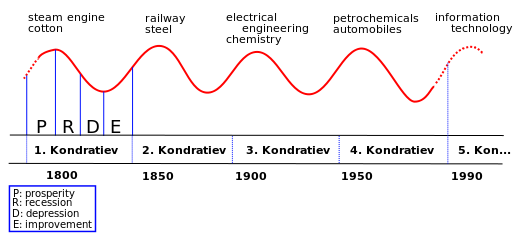
In recent days, the global finance and stock markets all experienced severe fluctuation. Major economies all seem to be depressed. In my opinion, present economy is just on the critical point defined by Kondratiev waves and at the meantime, China also demonstrates "new normal" with its own characteristics.
Today, one of the basic characteristics for the world economy is the dilemma of "de-leveraging" and "leveraging". On the one hand, for the purpose of economy recovery and avoidance of the repeat of previous financial crisis, de-leveraging is adopted as one of the main measures. However, during this process, the operating targets of the private sector are converted from "maximizing profits" to "minimizing debt ", which further leads to consumption slump, investment stagnancy, credit shrinking and economic recession. On the other hand, in order to avoid the occurrence and spread of this situation, governments have to leverage to stimulate economy which leads to heavy debt burden. Then, the economy is exposed to the hidden dangers of fast de-leverage.
As for China, it is now facing the "new normal" which appears during the new stage of development. It means, in terms of economic risks, various implicit risks gradually become explicit; while the overall risk is controllable, the battle against various risks featured by high leverage and bubbles will last for a certain period of time. In terms of factors of production, population ageing is aggravating; the number of extra agricultural population is dwindling; and economic growth will rely more on the quality of labor capital and technical evolution. Market competition will be gradually turned into competition dominated by quality and differentiation. The integration of the domestic market and enhancement of resource allocation efficiency will be the intrinsic demand of economic development. In terms of resource allocation and macroeconomic policy, the marginal effect of overall stimulation policy is diminishing.
If we want to jump out of the possible stagnant growth in long-term, we should no longer rely on the short-term monetary policy which is intended to enhance aggregate demand, but the fiscal policy which can directly affect the aggregate supply and its structure.
What we can expect is that when the world economy is in the "new normal "status as defined above, the economic growth in future may present less fluctuation in a quite long period of time. The potential growth rate will show slowing down and moreover, the status that the actual growth rate becomes lower than the potential growth rate will also become normal; economic cycles of countries become out of step and policies diverged, resulting in difficulties in achieving macro economic targets in countries who implement beggar-thy-neighbor policies; trade protectionism will rise again and globalization will see certain degree of recession. Global governance will step into a vacuum status and traditional international governance mechanism may fall into malfunction.
Under such a background, macro-control measures need a new approach that is focusing on supply. Both theories and practices show that the changes under new normal all appear in real economy, more specifically, in the supply end. The above macroeconomic policies taking regulation of aggregate demand as the target have already fall into a paradox and thus in need of adjustment.
The key point for reform lies in the supply end, including encouraging innovative business, accelerating educational development, enhancing human capital and the elasticity of labor market, raise retirement age, reform social security system and immigration policies and improve corporate tax system. At this turning point, "identify new normal, adapt to new normal and lead the trend of new normal" seems to be more important than in any other time.


