

Enhancing innovation: China should start with imitation
McKinsey recently released a report titled the China Effect on Global Innovation which attracts the eye-ball of the public by stating that the huge sums invested by Chinese government into the scientific and research innovation fails to get proportional results: Since 2006, the absolute amount invested by Chinese government has already achieved the world second place, closely next to the United States. However, the large sum does not satisfy the anticipation. For instance, as a giant with the largest amount of patent application, the contents of the Chinese patents are more in name than reality. And the amount of patents registered with the Patent Bureaus in the United States, Japan and Europe is far from the number of the American, Japanese or German patents.
As for me, this is not at all surprising but is a truthfully reflection of the current economic strength of China. In accordance with IMF statistics, China's GDP per capita based on purchasing power parity (PPP) is just 24% of that of the US; and calculated on the basis of exchange rate, Chinese GDP per capital is even lower at 14% of that of the US. Why we value GDP per capita as an important factor when we compare economies between different countries is because it can evaluate the labor productivity of a country and thus lay the foundation for all other indicators. When the GDP per capita of China is only 14% of that of the United States, we cannot expect the Chinese research fellows to make the same accomplishments as their American colleagues.
More importantly, for different countries, even different developing stages of a same country, the connotation and extension of innovation may be quite different.
China has invested heavily in science-based innovation but has not seen commensurate results
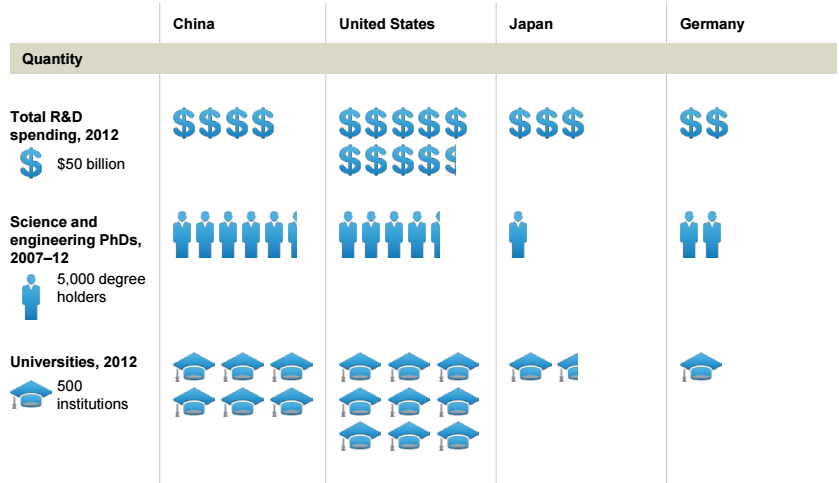
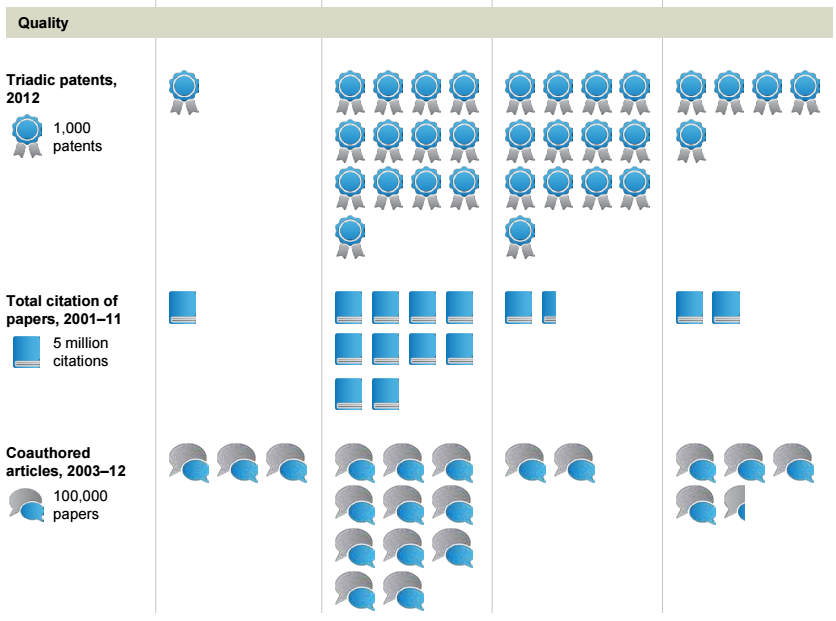
Source: The China effect on global innovation, McKinsey Global Institute
For countries like the United State which stands at the frontier of science and technology, technical improvement is mainly driven by independent research and innovation or driven by technical and resource immigration through international trade. However, as for developing countries, there is obvious spill-over effect of technical innovation from developed countries, by which, developing countries may realize innovation by imitating advanced technologies from other countries. In such case, the connotation of innovation for them are mainly encouraging direct foreign investment, purchase of advanced technical equipments and other means to imitate and learn advanced technologies imported from other countries. Currently, except several areas, what we need to do is not to invest resource in large scale into the most cutting-edge areas, because our capital stock per capita and technical stock per capita are both insufficient to support such effort.
In fact, China has, during the economic growth of the past three decades, just adopted such a pathway: it constantly introduced new technologies, imported advanced machines, equipments and professionals and achieved innovation out of imitation. At the beginning of the reform and opening up, China, by utilizing its cheap labor and by encouraging direct foreign investment and economic activities such as " processing and compensation trades" as China called it, developed an export-oriented labor-intensive industry and therefore created a positive environment for domestic enterprises to learn and borrow advanced foreign technologies and experience. In accordance with statistics, from 1990 to 2013, the direct foreign investment introduced into China has increased by 12 times and the imported electromechanical devices have increased by 4.4 times. In 2012, the export of China's high-tech products accounted for 26% of its manufacturing export, exceeding the level of the United State of the same period. During this process, China, itself, had also made huge progress and achieved world leading level in some areas.
Actually, China is not unique in this. Singapore, Japan, Korea, and China Taiwan all had the same experience in the middle-late period of the last century: they firstly enhanced their domestic labor productivity through learning, introducing and imitation and then successfully made economic growth.
Certainly, emphasis on "evolutionary style" of innovation which gives priority to imitation does not mean that we will ignore the importance of independent research and development. In fact, there are already Chinese enterprises which can compete with the foremost international tycoons. Huawei is one of them. In the past decade, Huawei invested cumulatively more than 190 billion yuan in research and development. As showed in a report about global R&D expense released by the consultant institution Strategy, Huawei has invested almost the same sum in R&D as those industrial titans like Volkswagen, Samsung, and Intel. And these giant investments have endowed Huawei with technical patents and technical standards equivalent to international leaders.
However, it is not possible that all Chinese enterprises can grow into a company as Huawei. When our labor productivity per capita is only 1/7 of that of the U.S, impractical pursuit of being the top of all areas may possibly lead to massive cheating. For a developing country, the right thing worth doing now is to enjoy the technological spillover from developed countries so as to gain maximum yields while using rationally small input. "Imitation-innovation" will still be our theme for quite a long time.
Published in China Times


