

A brand new period for Chinese commercial development
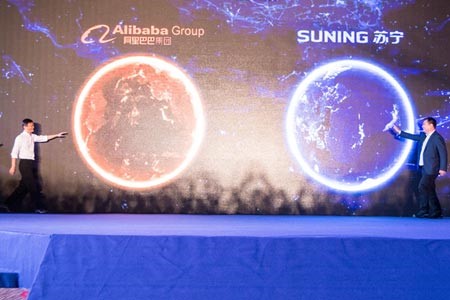
Recently, one piece of released news has aroused hot debates--Alibaba Group(Alibaba) has invested 28.3 billion RMB in Suning Commercial Group Co., Ltd. (Suning).Until now, Alibaba has become Suning’s second largest shareholder.
Suning used to have mighty negotiation ability as a conventional appliance platform, while the situation has changed ever since E-business develops fast.
Unlike common small commodity, the rule of "try it before you buy it" is very important for major appliances and electronic devices. It is really hard to image that Chinese consumer will pay 20,000 RMB for a 60inch LCD TV only with googling it on internet rather than watch the actual product.
For a long time, consumers are smart to compare price on the internet and order the product online after they have experienced it in a real store offline, which is regarded as a “free ride” effect. This chronic “experience spillover” of “seeing the product in one store, while buying it in another” separates cost and utility. One of the operators is meant to be a weaker side in the competition. It is shown in relevant data that Suning has paid 3.6 billion RMB for the rent in 2011. In other words, a growing number of Suning real stores costs more, which is the disadvantages of operating real stores. However, it gives a great opportunity for consumers to try in real stores conveniently and to buy the product online, which brings more benefits for Alibaba. In fact, Best Buy which gives a more excellent experience for consumers failed in China just because experience-spillover-effect resulted in high cost and low profit.
Even if Suning has tried to change business mode with establishing Suning.com, there is still a long way to change the fact that there are too much real stores, employees as well as the bond to corporate culture one on hand, while on the other hand, Taobao, Tmall and JD have occupied E-business.
With the mobile internet in ascendant, the situation has changed a little. In O2O age, the mobile internet keeps changing conventional industry, but whatever it does, one of the “O” is always representing offline of which essence couldn’t be replaced. For offline sales, real stores represent logistics resources of location, employee, etc., not to mention better experience and higher quality service. Consequently, more than 1,700 national-wide-distributed real stores of Suning, Suning plaza of commercial real estate subordinated to it, Suning life plaza, 5,000 after-sales service and service stations in four or five-titer cities could better make up for O2O offline resource weakness of Alibaba.
It is claimed in a staff email sent by Zhang Yong, the CEO of Alibaba, that by combining consumer electronics and major appliances of Suning with Tmall appliance, a strongest combination will be born; the offline delivery and installation service system created for years by Suning will serve all consumers and sellers in Taobao and Tmall. Suning’s more than 1,600 offline real stores covered all key cities and regions will connect to Alibaba thoroughly as well.
The past competitors could become partners just because both sides have a clear prospection for the development of E-business in next level.
Not only Alibaba and Suning chooses this strategy,but almost at the same time, JD, Alibaba’s competitor, declares to become a shareholder of Yonghui Superstores Co., Ltd., which is a strategy for JD to improve the level of supply chain and strengthen its power in O2O.
A few years ago, E-business develops fast, while real stores of Suning and Guomei declines. Look at the fact now, the combination of Alibaba and Suning reflects China’s upgraded consumption, changing from focusing on price to shopping experience and quality. In the point of commerce development, it will be a brand new commercial period following conventional real stores and E-business.


