

Raising minimum wage is not the solution to beat income gap
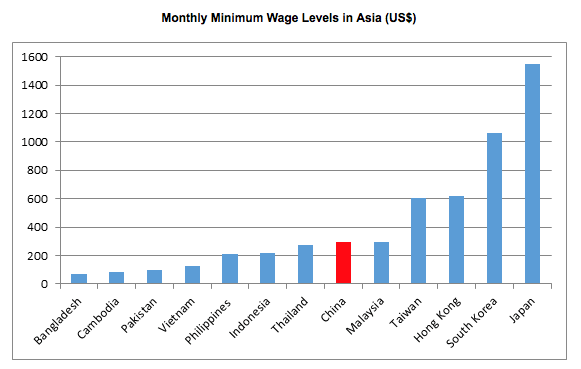
(Source: China Labour Bulletin, 2015, Carsten Wortmann Global Partners)
Multiple provinces and regions raised minimum wage levels since July, 2015, among which, Shenzhen and Shanghai have increased their minimum wages to more than 2,000 yuan (US$322) per month, the highest rises so far this year.
Although there’s no clear conclusion in economics about minimum wage’s influence on improving salary of low income population and economy growth, many countries have released the minimum wage system based on political correctness.
China has released Provisions on the Minimum Wages of Enterprise in 1993 that shall be followed and executed by all employers in China, while the minimum wage standards shall be issued by relevant local department.
Even if China has brought in “the minimum wage” system, this system has not been well implemented. To begin with, this system aims at non-agricultural labor working in city. Since the rural agricultural production is always self-employed, a mass of peasants cannot adapt to the minimum wage naturally. Since a majority of rural enterprises are not formal, these employers and employees do not follow the minimum wage regulation voluntarily, which means 0.38 billion rural workers in the 0.77 billion labor force in 2014 can’t be protected by the minimum wage.
However, the urban-rural income gap is the main source of income gap of the Chinese. The working reward to urban labor force is far higher than the one in rural, which means, agricultural labor is continuously pouring to cities hunting for jobs even they earn the exiting minimum wage. The labor supply, especially the low-skilled labor paid with the minimum wage is too sufficient to be easily replaced. Considering the conditions of low-skilled labor supply and demand, the minimum wage standard shall not be set up too high.
In fact, the present minimum wage is not very low. In 2014, China has an wage income per capita of ¥1,1420 ($1836 in current dollar) including peasants, while the labor force participation rate is taken into consideration, the monthly wage is only ¥1684($270). And yet the minimum wage of Beijing in 2015 reaches ¥1720($276), higher than the national average wage income. In this way, how can the labor refuse to work in Beijing?
The minimum wage standards in recent two years are being promoted fast. It is claimed by the All-China Federation of Trade Unions that wage adjustments from 2011 to 2014 were 22%, 20%, 17% and 14%, which are far higher than the national average wage income growth and further hold up the adjustment range of minimum wage. Consequently, the minimum wage standard across the country grows about 10% in 2015.
What’s more, although the minimum wage is far higher than the peasant’s income, it still fails to afford the living in city.
Under this circumstance, it is never important how much the minimum wage shall be set up, what’s matters is to increase income for all and reduce urban-rural income gap. Two things shall be done specifically: on one hand, reduce tax, governmental fund, social insurance proportions in GDP, which take nearly 40% of it; on the other hand, promote free labor flow and reduce urban-rural income gap by permitting migrant workers to work in city. Only when there is less salary gap between different industries and between urban-rural areas, the minimum wage can really mean something.
Published in The Beijing News | 2015-7-24


