

To make unemployment rate more reliable
China’s Official Unemployment Rate (2003-2012)
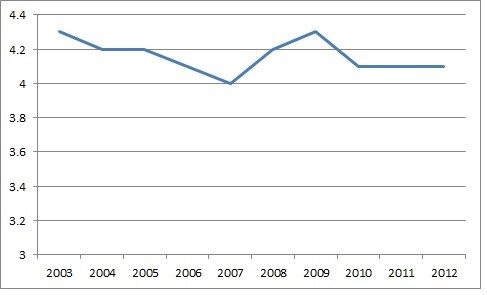
Source: http://www.clb.org.hk/en/content/employment-china
On June 10th, Premier Li Keqiang required to improve China’s employment data to be “the real authoritative data” at the executive meeting of the State Council. Later, the National Bureau of Statistics announced to conduct a new labor markets survey as soon as possible. It is reported that in July, the scope of labor employment survey will extended to all prefecture level cities.
In any textbook, four macroeconomic indicators can be seen: GDP measuring economic growth, CPI measuring inflation level, unemployment rate measuring idle capacity and the international balance of payments. After many years of practice, China’s GDP, CPI and the international balance of payments has become mature. Although GDP statistics are still controversial and the target basket constituting CPI is also opaque, generally speaking, these three indicators are basically in line with international standards with strong authority.
In contrast, the statistics of unemployment rate is not rigorous.
The full name of the existing data of unemployment rate in China is “registered urban unemployment rate”, which is based on the number of people who apply for state benefits and job-seeking assistance in the event they find themselves out of work. Judging from data, registered unemployment rate in all cities in the country remains for a long time at about 4% and it doesn’t fluctuate with economic cycles. As a result, this supposed-important indicator was abandoned using in macroeconomic policy-making.
Migrant workers - those who have moved to cities to find employment - can't register for benefits in their new locales because they typically don't have residency permits, meaning the reading effectively excludes more than 200 million people.
Since 2000, although the registered urban unemployment rate can not reflect the unemployment situation, the statistics department has not paid special attention to the improvement of the unemployment rate data statistics. There are 2 major reasons for this. First, China's labor market is in great transformation, and there is an annual increase of more than 10 million of labor force (farmers move to cities to find jobs, college graduates with bachelor degree or above). Even if the economy is prosperous, the pressure to create new employment opportunities is also great, and the government often takes replacing unemployment rate by new jobs as the macro goal. GDP data is relatively more important. It determines the number of new jobs. Second, the employment volatility of migrant workers is great as they can go back to rural life. Then the uncertainty of the numerator and denominator of the unemployment rate is high, and the unemployment rate is difficult to serve as reference for macro control. That's why there was a high estimated unemployment rate in the market several years ago, but there is no crisis in society.
These two cases have changed in recent years. First of all, GDP growth starts to slow down and the new jobs created by economic growth are not so many as before. Understanding the real situation of unemployment is more important for macro control and social stability than the period of rapid economic growth. Second, net labor transfer from rural area to urban area begins to slow down, and the working-age population in the country declines. With post-80s migrant workers becoming the main force, migrant workers from countryside tend to settle in the city. Although they came from the rural areas, the majority of them will not or can not engage in agriculture. They have completely transformed into non-agricultural labor force. To provide them with stable jobs in the city is the obligatory responsibility of the government. Unemployment rate has become an important indicator of China’s macroeconomic cycle, which can not be ignored any more.
The new survey's design will follow the International Labor Organization's standards, and it can avoid the drawbacks of currently registered unemployment rate, such as difficult registration of unemployment, omission or lack, unemployment but pay social security tax, and linking to household registration and so on. For the government, the unemployment rate data can revise the disadvantages brought by current economic macro-control with GDP as the core objective.
At present, for example, the urban survey unemployment rate in May was only 5.1%, showing a downward trend. What is more, the unemployment rate of non-agricultural household registration and the youth dropped considerably, and economic recession did not bring great unemployment pressure. This means that the government may not need to make a bigger stimulus to economy. Of course, economy recessed but the unemployment rate did not increase, which also means the reality of long-term labor shortage in China and that the government shall take measures in the field of family planning, immigration policy and so on so as to meet the potential crisis in the future.
Published in the Beijing News


