

Sino-Japan technological gap should be confronted squarely
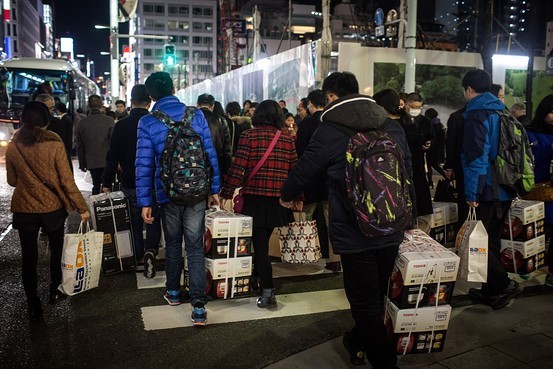
Tourists carry purchases made at a tax-free store in the Ginza shopping district on Feb. 20 in Tokyo. (Getty Images)
Recently, the media has reported that there are as many as 450,000 Chinese tourists during the Spring Festival going to Japan for consumption which is as high as nearly RMB 6 billion. In addition to the still booming traditional hot commodities like electric cookers, the high-tech toilet seat has become another hot commodity of this year. The local Japanese media reported that the toilet seat was almost out of stock.
The Japanese high-tech toilet seat has specific consumer groups
In comparison between its price and functions, the toilet seat, E-enabled, intelligent and with functions of warm-water washing and drying, has limited increase of marginal utility. Apparently, the high-tech toilet seat, compared to public washroom, private bathroom, is the least wanted. Just because of this, not all people having purchase power will buy it. On the contrary, the promoted utility brought by the same money is the least. This is indicative that the electronic toilet seat is a typically product of consumption-upgraded.
So, the consumers able to purchase the product all belong to middle class, or even upper middle class who have residual money and leisure time. In addition, thanks to the great use of social media, more people are likely to do these shopping and then show off. Moreover, as reported by Japanese enterprises, although the toilet seat is exported from China to Japan, its production standard is entirely subject to relevant standard of Japan, and the price in Japan is cheap due to lower consumption tax. Therefore, it is not weird for the phenomenon of rushing to Japan for high-tech toilet seat purchase.
Gap of industrial chain should be confronted squarely
However, in the final analysis, it is because of performance superiority that causes the Chinese to madly purchase electric cookers or toilet seats in Japan. Though the media discovers one popular high-tech toilet seat among Chinese tourists in Japan is produced in Ningbo, it is manufactured with Japanese technologies.
These seemingly simple products are in fact not simple. The tight plastic parts reveal injection molding behind it; it should depend on sensor and software to judge the water temperature and air pressure, and machine intelligence; the durability is related with the material and heat treatment; after these links are finished, the last link is skill and responsibility of workers on assembly line. In addition, since it is commercialized manufacturing, it also needs certain cost from R&D to assembly. Therefore, the electric cooker or toilet seat is indicative of the overall strength of the state industrial chain.
There is someone commenting that China should put attention to warcrafts, aircraft carriers or moon landing, etc. rather than these pinheads. However, the latter is produced irrespective of cost. To certain degree, the electric cooker reflects greater advantages in market economy. Therefore, it is not queer to praise Japanese electric cooker, and we should confront it squarely, rather than being wrathful.
It should be noted that China is making continuous progress in production technology in addition to rapid development. The world factory, created by 30 years of opening up and reform and intense market competition, has a reputation abroad and also is worthy of the name. However, at the same time, if we are to quickly diminish the gap with foreign countries, we can not rely on foreign transferred technology to enhance production efficiency or competitiveness any more. Only technical innovation is the way out for Chinese manufacturing.
Published in Beijing News | 2015-3-2


