

Why does China need professional farmers?
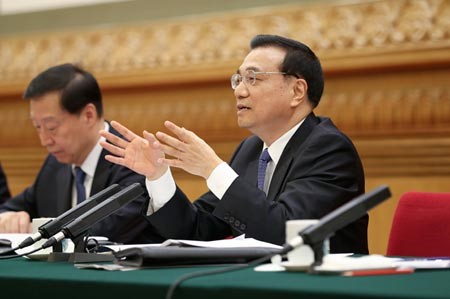
Li Keqiang speaks at an NPC session on March 7, 2015. (Photo/CNS)
It’s interesting that the 2015 government work report proposing “training professional farmers”. In traditional concept, “farmer” is more a status than an occupation. Since it is an occupation, we can not avoid coming to the topic that who can be farmers because those who are born as farmers are not really suitable for being farmers.
The professionalism degree of Chinese agriculture practitioners is low
Who will be farmers? It seems like nonsense in China for the reason that farmers certainly come from farmers in past concept, except in certain time when the population flows from urban areas to rural ones – from urban residents to farmers. However, for the majority of time, people flows from the rural to urban areas. The past 30 years has witnessed a large scale transfer of agricultural labor force with rapid growth of Chinese economy. As shown from data of State Statistics Bureau, the proportion of agriculture practitioners among all practitioners has decreased from 70% of 1978 to 59% of 1990, and 31.4% of 2013.
The farmers from rural to urban have not only improved their own situation, but also supplemented insufficient urban labor force after the opening up and reform, etc.
Actually, the agricultural production has not withered due to leaving of more and more farmers. On the contrary, the grain total output has been creating one after one new record. A group of comparable data for this is that the gross grain output was 304,765,000 tons in 1978, and 601,938,400 tons in end of 2013. Despite increasingly high agriculture output year by year, the number and amount of imported agricultural products have been on the rise all the time. Since being a member of WTO, China’s grain trade scale has been enlarging, and mainly for the import. In 2002, China had 14,170,000 tons of imported grains, and 77,960,000 tons in 2013.
Why should we still import so much food after harvest? There are several reasons for this. One is cost advantage. China mainly imports grains from Europe, America and other developed countries with large scale production scale of grains and low unit cost, therefore the price is low. The other reason is diversified demands for tastes. Although many imported agricultural products are not cheap, everybody still run after them. One factor for this is diversified consumption after increase of income.
Why can’t domestic agricultural production decrease the price of agricultural products or satisfy consumers’ diversified demands? Certainly, the agricultural product is closely associated with the natural endowments of the area. However, as for many agricultural products, it may also be closely related to the practitioners’ skills except the natural endowments.
Reform to rural land system is necessary for appearance of professional farmers
Compared with large scale production of European and American agriculture, the biggest problem for Chinese agriculture is insufficient scale and low professionalism of practitioners. In China, farmers exist more as a status than as an occupation. In Europe and America, the agriculture is dominated by a group of occupational farmers armed with modern professional skills, while, in China, the agriculture relies more on traditional experience or natural conditions. Just because of this, Premier Li Keqiang proposes in government work report to “train professional farmers”.
How to train professional farmers? Many people may think to help farmers “acquire job qualification and enhance average income through training of vocational skills and professional ethics”, just as the same of practicing lawyers or accountants. However, is this workable? I think it’s not necessary. One point is that professional farmer, after large-scale agricultural production, is more like an entrepreneur that needs to collect and judge various kinds of market information. If we can not judge the capability of entrepreneur through practicing certificate, neither can we do so for farmers.
In my opinions, the most important point for professional farmers is to lower the access requirements. Among the current institutional framework, farmer exists as a status, which means that many urban residents can not go to the rural areas for becoming professional farmers. Due to restriction of rural land system, they can not be engaged in agricultural production; or can not enlarge the scale due to restrictions of all kinds of factors. This is very similar to beginning of 1980s when the government confined farmers into cities: the State Council released a Notice on Strict Control over Rural Labor Force Working in Cities or Transferring into Non-Agricultural Population on December 30, 1981, which demanded urban companies to strictly control recruitment from rural areas, carefully clear rural labor force of enterprises and public institutions, and strengthen household or food management, etc.
However, the subsequent fact proves that the rural-to-urban transfer trend is uncontrollable. Since farmers can go to the cities for workers, why can’t urban residents go to the countryside as farmers? This might be a phenomenon to be confronted in future process of urbanization. Certainly, this needs reform of rural land system. Only through this can professional farmers appear in China.
Published in Beijing News | 2015-3-6


