

Hope Guangdong relax birth control policy soon
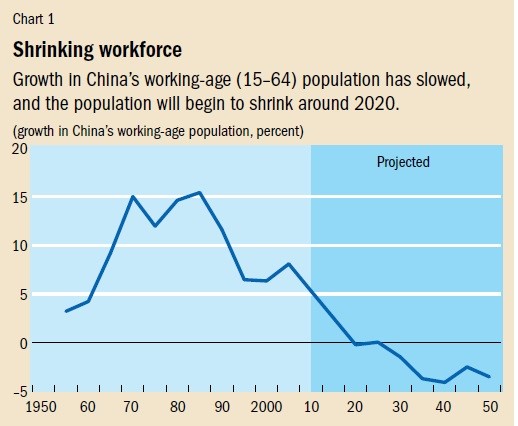
Source: Mitali Das and Papa N’Diaye, 2013, "The End of Cheap Labor", IMF publication Finance & Development
Recently, there have been some committee members proposing that Guangdong Province should endeavor to win the permission from the central government for easing population controls and allow all couples to have a second child at Guangdong Provincial CPPCC. China has been implementing the strictest policy in the word to control births for more than 30 years. For the time being, China is facing population crisis: its natural growth rate of population has been dropped from 25.8‰ of 1970 to 4.92‰ of 2013 which is less than half of the world average level; the total fertility rate of women has been dropped from 5.8 of 1970 to 1.55 of 2013 which is below the replacement fertility of 2.1; the working-age population, aged 15 to 59, has been declining for 3 consecutive years since 2012.
Under such kind of circumstance, local governments have been gradually easing the population control that allows qualified couples to have a second child according to the permission from the central government. With such policy change, authorities in many places had worried about bounce of fertility within a short time. In fact, there is no fertility bounce at all. Based on statistics of China’s National Health and Family Planning Committee (NHFPC), there are only 1 million couples applying for a second child among the 11 million qualified couples by the end of December of last year. To support sustainable growth, China’s population restriction should be loosened as soon as possible.
As for Guangdong, a big province where labor-intensive enterprises agglomerate, recently has been confronting the problem of capital flight brought about by shortage of migrant workers and increase of labor wage. Therefore, a stable and rapid population increase is of vital importance to it.
If Guangdong is encouraged to be the vanguard to allow all couples to have a second child, it must need necessary supporting policies:
First of all, the Guangdong governments of all levels have been famous for strong policy inclusiveness and great convenience for the people, so it has the necessity to further simplify birth policy.
In the second place, Guangdong should lower its requirements on birth control as much as possible on the basis of national legal norms, cancel policies stricter than the national standard, and remove the constraint on residents’ fertility desire.
These are the basis. There are two reasons for low fertility willingness of residents: one is that people have been accustomed to the family planning policy due to its thirty-year-influence; the other is China’s higher costs of living. Experiences in other countries show that boosting the fertility rate is a tough task and it takes a long time to see the effects.
In terms of non-registered residents, there is another trouble: that’s how to receive free compulsory education. These children are often ineligible for enrollment in urban public schools even if they were born within the district. Taking Guangdong as an example, Children of the non-registered residents can go to public schools when they “have resided in the same residence and paid social insurance for five consecutive years, have stable occupation, have residence permit, etc”. As to the majority of non- registered residents, this is an unattainable obstacle.
If Guangdong is to promote the implementation effect of corresponding policies, the greatest edged tool is to cancel the educational threshold on admission of non-registered residents’ children. After removing the above worry, the migrant households will be more motivated to settle down in Guangdong.
Published in New Express | 2015-2-10


