

China’s gloomy economy in 2015

Taking a retrospect to the year of 2014, Chinese economy is still growing with increased leverage. That’s to say, the debt and excess capacity are still accumulating.
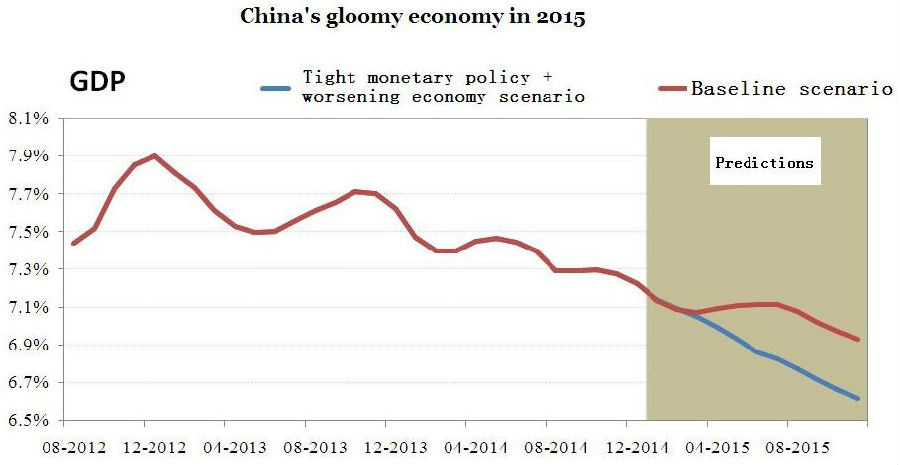
Previously, China’s central bank released a report forecasting Chinese economy which adopted our Logit-VAR monthly forecast model. It is predicted according to our model that China’s economic situation is not good in 2015. The predicted value for GDP growth is about 7% or even 6.8%. Worse still, our predicted value may further be lowered down with unveiling of various data in the future.
A key factor is the deflationary pressure reflected by PPI which essentially reflects the operation incentive of Chinese economy in a short period. PPI is one of the most important factors determining a company to increase or decrease its production. When the PPI is on rise, your inventory will be profitable and you know there is market demand for your products. Then you will expand production and come up with higher product demand to the upstream industry, therefore the PPI of upstream industry will be promoted and form a circulation of positive feedback.
Seeing from the data, there has been more than thirty months for China’s PPI to be negative and the downward range is expanding. Moreover, the growth of industrial added value is still declining, indicating the enterprises are still actively destocking for the time being. This is a behavior of self-reinforcing, and seems to have no trail of end by now. At present, I can’t see when the PPI will turn positive, which is unprecedented in Chinese history. Chinese economy is confronting the overwhelming pressure of excess capacity.
In this case, China will maintain loose monetary policy in 2015 and the fiscal deficit will expand. Meanwhile it will be difficult for the company profits to get better and the bubble degree will be deepening.
In the future, the following black swan incidents will possibly happen in Chinese economy:
Firstly, will China’s central bank be forced to protect exchange rate of RMB?
Recently, this problem has drawn a lot of attention. If all the people in the market feel that the central bank is forced to protect exchange rate of RMB, then the consensus would reverse the entire international fund and domestic residents’ allocation demands on different currencies, and strengthen the tension of domestic economy through many chains. Although China’s central bank has a huge amount of foreign exchange reserve of US dollars, the whole situation will be pretty bad if news on protection measures of the central bank keeps emerging in foreign exchange market and the foreign exchange reserve decreases by 100 billion or 200 billion us dollars monthly.
Secondly, will there be defaults of partial debt? China has more than thirty provinces and each area has totally different situations. In some weak places, there could be a worse economic situation.
Thirdly, will there be political or social risk when unemployment and economic problems arise?
Excerpted from LIU Haiying’s speech in Hongru Forum held in Feb.11


