

The slowdown of China's FDI
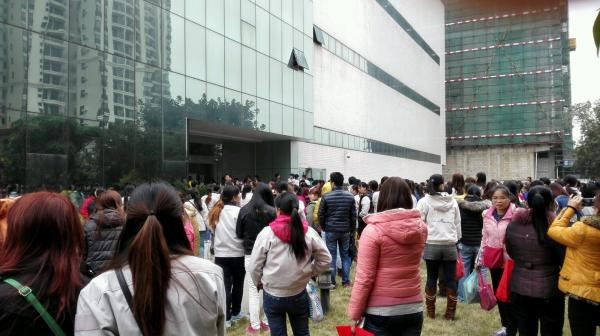
Workers wait outside the office building of Japanese watch maker Citizen in Guangzhou, Feb 5, 2015. [Photo/thepaper.cn]
On February 5, more than 1,000 employees lost their jobs after the sudden closure of Citizen Precision (Guangzhou) Co., Ltd., a production base for Japanese watch brand Citizen. Each worker would receive a redundancy package consisting of one month's salary and economic compensation based on the number of years they have worked at the company.
Nevertheless, the employees are still “shocked”, for they care not the amount of compensation, but a steady job. As for the low-end labor force, the job opportunities in foreign manufacturing enterprises are really very, very precious. However, in recent years, the manufacturing departments of foreign enterprises have closed their factory in succession. Especially for some labor-intensive enterprises in Guangdong, many of them turned to their own countries or Southeast Asian countries.
Why are there so many foreign enterprises ending its Chinese operations and quitting China?
First of all, the production cost in China is higher than before.
Recently, the land cost in Guangdong and other places are continuously rising, as well as the requirements on environmental protection. However, the tax preference has been getting less and less, therefore the foreign investment yields in China is reducing. The labor cost is rising in an astonishing way. Subsequent to the subprime crisis, the salary in most countries of the world is diminishing in varying degrees. However, its growth has never slowed down in China and even remains No.1 in the world for many years. Even so, China’s workers still have higher expectations. Last year, the workers of Galanz (Zhongshan) smashed the factory, protesting the salary was lower than their expectations, and finally this evolved into a group event.
In the second place, starting from 2012, there has been a greater extent of appreciation in RMB than other currencies. For instance, the exchange between RMB and JPY was 1:12 at end of 2011, and nearly 1:20 by the end of 2014, in which the premium of exchange rate to JPY is more than 60%. At the same time, the salary of labor force is rising in China, while remains unchanged basically in Japan. When we combine the quality of labor force and salary level, it seems that China’s labor force is not cheap and fine.
In the third place, the increasingly heavier burden of social security payment has made the enterprises be overwhelmed. The social security payment crisis arising from aging population has become unavoidable pressure of many places, and the government no longer exempts the enterprises from the obligations of paying social security for non-resident employees. Taking CITIZEN as an example, according to the media reports, many of its workers come from the Midwest. Previously, the company didn’t have to pay social security for them or the payment level was extremely low. However, about in 2010, it was mandatory that enterprises must pay social security for non-local household labor force across the country. The problem is the employees have no direct access to the benefits, so it fails to achieve the purpose of attracting and motivating employees and purely makes contribution to the retired employees.
In fact, the social security payment burden has become the most important factor for loss, bankruptcy and liquidation of medium and small manufacturers. In 2014, the national social insurance fund was predicted to be 3.7 trillion yuan which was nearly 30% of the national fiscal revenue of that year. Ultimately, it is because the government takes too much from the enterprise and laborer that makes the enterprises feel the cost is too high and the laborers feel the income is too small. The hostility between capital and labor resulting from the above also becomes one of the main reasons for withdrawal of foreign investment.
From the macro perspective, in recent decade, the government has mightily intervened the economy and interrupted the adjustment of economic cycle. Although this has controlled the risk of short term unemployment and asset bubble burst as a whole, it makes the price of factors like labor force and land rigid and rising, and thus undermining China’s attractiveness to FDI. This is the system background for foreign capital to withdraw from China.
We also have to face another problem: as for foreign enterprises, they can withdraw from China; then how about the domestic enterprises? The majority of them know nothing about operation of overseas market. Higher business operation cost will force the capital to withdraw from real economy (especially labor-intensive industry), which will not only heavily hit the job market and further worsen the trend of economic downturn, but also intensify asset bubble and increase financial risk. Therefore, the policymakers should be prudent in dealing with it.
Published in oriental Morning Post | 2015-2-10


