

Riding the bubble of China stock?
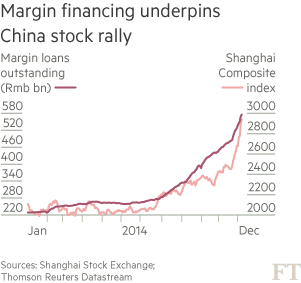
All of sudden, China’s stocks rise like a bull market.
What confuses people is that such a rise lacks the support of market fundamentals. According to our predictions, the growth of China’s GDP in 2015 may reduce to below 7%. The huge excess capacity may result in large demands of debt roll-over, continuing to push the debt leverage (or debt to GDP ratio) of China who has always remained the first around the globe. It shows that the nominal GDP growth is backed by the rising leverage. Then, such growth not only overdrew future economic potential, but also caused the dilemma of micro economy in moving forward.
From the data of listed companies, compared with the end of last year, non-financial listed companies have achieved a rise of 11% of the total assets with the 12% growth of liabilities, resulting in the rising debt ratio from 66.2% to 66.8% in the third quarter this year. It stands out prominently for its increased leverage. What worries people is that although economy can maintain nominal growth by the adding leverage, investors can only earn a low return or no return. As of October of this year, the PPI has been negative for the 33 consecutive months, revealing the huge pressure of the real economy. As far as return rate of investment is concerned, ROE of non-financial companies have reduced from 9.75% to 9.58%, 17 base points down.
In our economy, the following vicious circle has been formed: excess capacity results in low investment return rate and widespread zombie companies, the latter resulting in huge debt roll-over so that ineffective capacity will keep on and in turn pushed high investment, financing and excess capacity.
Such vicious circle fuels China’s stock market bubbles. Under the pressure of sluggish economy, the central bank will pump more money into the financial system. Or else, debt chain that has been stretched to nearly the full will probably break one after another at the weakest point and the weak economy will probably turn into a crisis.
With the easing policy and its expectations, China’s stock market needs a revaluation.
In the above-mentioned economic environment, the investment return rate will surely not rise again. According to our prediction, next year’s profit will at most remain the single-digit growth, falling behind the increase of assets and ROE will continue decreasing. In this way, the liquidity of easing policy releasing will probably flow to financial assets rather than the real economy.
When this happens, the two advantages of the stock market will play a bigger role:
First, the financing channels that listed companies own make it gain an upper hand over non-listed ones. Then, listed ones will gain the biggest shares in the upcoming industrial integration. Therefore, the gap between the two in the increase speed of profits will expand.
Second, as designated placement of new shares for financing for acquisition, stock markets have broken through the interest transmission channels between real economy and financial market. Although China did have excellent profit growth point and good companies before (taking BAT as an example), the profits created by real economy were hard to be shared by investors of stock market. Yet now, though such acquisition, promising companies and their profits can be shared with investors in China’s stock market.
If the real economy remains sluggish, more easing will come. Since both the housing market and trust products face their own challenges, prices of shares will rise with more liquidity. Then, the rise of stocks will encourage more inflow of capitals and become self-reinforcing. Such self-reinforcing rising of stock market without new profits can be regarded as bubbles.
In fact, market bubbles are apt to appear in the process of high-growth economies turning into low- speed ones. For example, to South Korea before 1997 and Japan before 1989, the logic among is similar to the above analysis.
The question is the bubble process has to take the testing the real economy all the time. The contradiction between huge debts and low return will at any time result in the breaking of partial payment chains and may at any time leads to disorder in liquidity structure in share market. According to definition, bubbles always realize self-breaking through reflexivity process. Therefore, bad news from real economy will end this carnival of bubbles.
Of course, before the breaking of bubbles, market participators can indulge themselves in although this kind of environment poses huge challenges to investing ability. As with the evolvement of investment competition to the stage of high technology, this game will become more disadvantageous to retail investors. As for institutional investors, they must also speed up growing up and construct better systemized investment management system. What is even more crucial is that professional institutions must level up their risk management ability. Are you ready for riding the bubble?
Published in China Securities Journal | 2014-12-3


