

Cost of APEC Blue
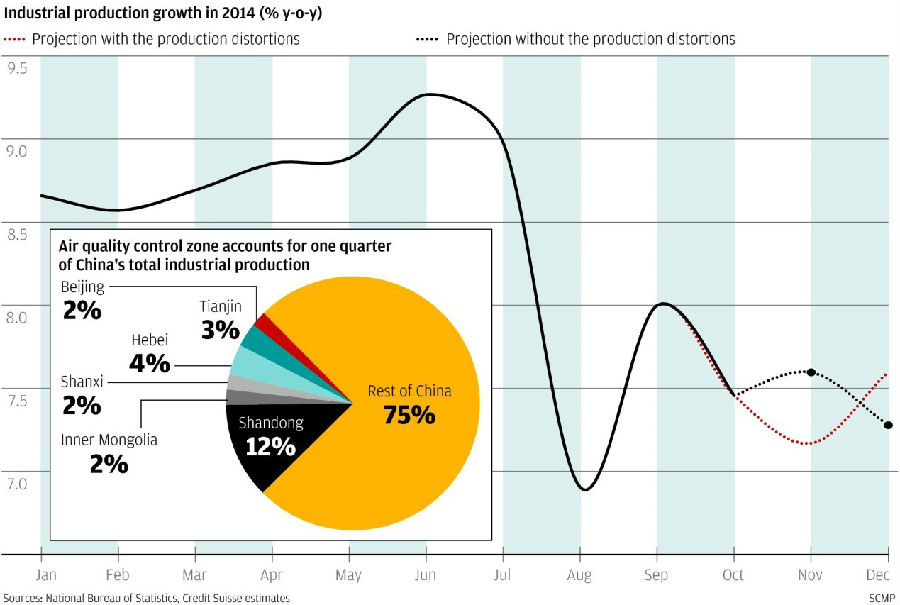
Chart of the day in the South China Morning Post print edition: Cost of smog-free Apec summit
APEC conference has been a concern of the whole nation for the reason that, on one hand, the grand topic for discussion is related to the development path of China in future several years or even longer; on the other hand, the conference has involved many interested parties and many measures to guarantee azure sky and smooth traffic, such as shutting down of polluting factories, granting special holidays to local government officials and other workers to reduce vehicles on the roads, etc.
In recent years, China has held many impressive events, like Beijing Olympic Games in 2008 and Shanghai World Expo in 2010. It’s not the first time for China to host APEC; 13 years ago, Shanghai has held the meeting for once; why APEC of this time has attracted special attention is that the topic for discussion has involved huge interests between countries, such as Asia-Pacific free trade zone, the Chinese-version Marshall plan, etc.
APEC conference is so important that the investment on it is certainly also huge. The cost of the conference covers direct cost and indirect cost. The first item in direct cost is construction of the main venue. According to the media reports, the construction of the main venue involves 44 specific projects, 5,100 acres of relocation and removal lands and estimated billions of project cost. In order to ensure safety, 1,000 sets of high-definition monitoring probes are been installed in Huairou District of Beijing where the main venue is located; the probes can discern human faces within 30 m and monitor them within a range of 500 m; at the same time, Beijing has launched high grade prevention and control for APEC, inputting 28,000 police in average every day.
In addition to the obvious direct cost, there is also invisible indirect cost. At first, in order to avoid haze and ensure azure sky and smooth traffic for APEC, Beijing has carried out measures like traffic controls, factory production restriction; and many provinces and cities surrounding Beijing have also implemented strict measures; taking Hebei as an example, there are more than 2,000 enterprises stopped or restricted their productions and over 2,000 construction sites terminate construction during the APEC conference; there are supervisory personnel at the factories or sites for 24-hour monitoring, and there are also full-cover and continuous tour of satellites and unmanned planes.
It is rare to see such stringent air security measures after the Beijing Olympic Games, and sky of Beijing is sure enough azure before the conference, which is jokingly called as “APEC blue”. We all know that “APEC blue” is at the cost of temporary restriction of enterprise production and loss of short-term GDP, which will be helpless to the improvement of environment quality from the fundamental. In consideration of the downturn economy of this year, these costs seem heavier.
As China’s power is on the rise and its enthusiasm in participating in international affairs is increasing, it is inevitable that it will host international conference and seek voice in international affairs. The higher the meeting level is, the more complex the security and ceremonies will be, and thus will inevitably cause conflict with the conference venue and surrounding daily life. Occasional and limited impact is acceptable. However, in case of frequent conferences, it will be difficult to carry out production halts, traffic controls and so on, and “APEC blue” will also gradually lose its glamour.
China has become an important country, so it should face the world in a usual mind. The international political and economic activities held in China will only increase rather than decrease, so only with a usual mind can avoid catching one and losing another. Seeing from a long term, the only way is to include such large-scale activity into normal urban administration.
Published in Xinmin Weekly | 2014-11-17


