

Great Challenge for China’s Marshall Plan
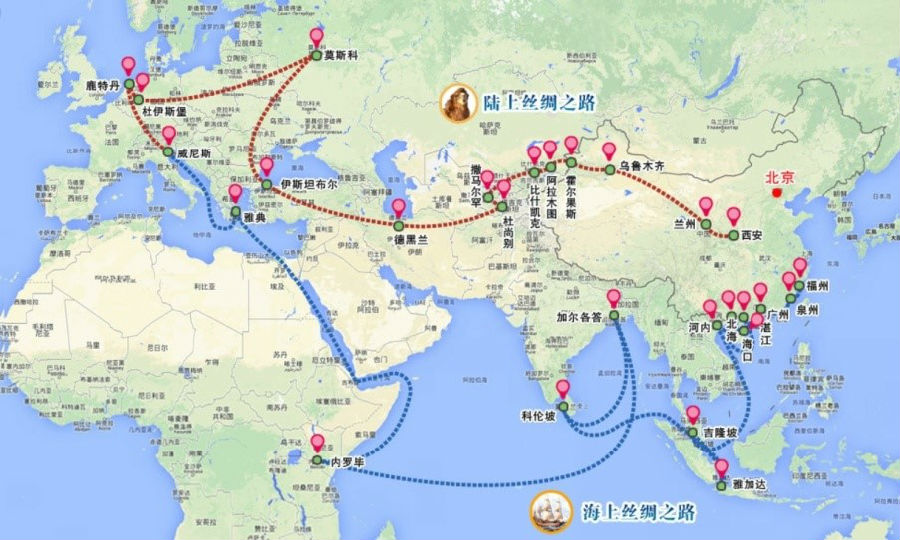
(The Xinhua News Agency released a map showing China’s ambitious visions for the “one belt, one road” initiative: “New Silk Road” and “New Maritime Silk Road”.)
Arecent series of measures taken by the Chinese government to increase its influence in Asian and global trade and investment have captured wide attention. On October 24, 21 countries including China and India signed an agreement in Beijing, jointly deciding to establish Asian Infrastructure Investment Bank (AIIB). The steps also include launching a US$ 40 billion Silk Road Fund to finance infrastructure construction and enhance business cooperation across Asia. So there were some people thinking China’s Marshall Plan was ready to come out.
Marshall Plan, also known as the European Recovery Plan, refers to American government giving economic aid to European countries for rebuilding after war. The European countries had accepted various kinds of assistance totaling 13 billion dollars (about 130 billion dollars of 2006 in consideration of inflation) from America, including finance, technology and equipment, which was equal to two thirds of America’s gold reserve at that time. The Europe during renaissance had to assist America to absorb its excess capacity due to its lack of production capacity, and the money lent out from America had finally returned to America. Therefore, the Europe and America had reached a win-win situation.
Currently, overcapacity is rampant in China, especially in industries pertaining to infrastructure construction. It is equally difficult to clear and digest excess capacity in confrontation with domestic urbanization and downturn international economic situation. Therefore, it is a good thing for China as well as other countries to implement capital export under Beijing’s “one belt, one road” initiative: such moves can reduce China’s excess capacity, drive infrastructure construction of emerging market countries and promote global growth. During this process, China can also deepen its influence on emerging market countries, and it is also an essential step for China to become a responsible great power of the region or even the world.
The plan is a good idea; however it may be not an easy thing to put into practice. Marshall Plan is a success because America has enough strength to ensure the countries borrowing money from it wouldn’t repudiate their debts, and, most importantly, the European countries can revive and develop with the assistance from this plan, while these countries are already globally developed countries with high degree of overall economic development and high level of human capital before World War II. The OECD established by these recipient countries is also an international institution mainly composed of “high income” economic entities which are few in number in the world currently.
When receiving aid, the infrastructure of these countries was destructed. However, there are great differences between them and developing countries. The return rate on investment to Europe after the war is rather high. Marshall Plan only needs to solve the problem of insufficient capital, without having to consider problems including low-skilled workforce, bad legal environment and unmatched local governance.
Countries involving in China’s Marshall Plan may lag far behind the European countries during Marshall Plan period. Under the “one belt, one road” initiative, development priorities will be given to countries of Central Asia, Russia, South Asia and Southeast Asia. The countries of the Middle East and East Africa are in the converging point of “One Belt and One Road”, and there is possibility to cooperate with some countries of Europe and Africa. Many of these countries haven’t finished transition of modernization. Moreover, many countries in Southeast Asia have territorial disputes with China, therefore our cooperation with them will inevitably bring in sense of standpoint, which is no little challenge for China’s foreign policy.
On the other hand, it is just because they haven’t finished or haven’t started transition of modernization, their labor force skill and infrastructure are backward than that of China, not to mention spirit of contract, commercial environment there. What’s worse, some countries even have an unstable political situation, such as Afghanistan and many countries of Africa. It is a problem that we have to face firstly whether the investment on infrastructure of these countries will be smoothly completed. It is a common thing that, in China’s investment in Africa, the former leaders make promises and their successors tear the contract.
Not to mention in foreign countries, even in domestic China, there are also a lot of examples indicating that hidden loss and unfair treatment are often suffered by central enterprise in local and state-owned enterprises of developed area in other areas during investment. Therefore, it is a very serious problem about how to guarantee the rights and interests of China on investment in South Asia and Africa, etc. for the reason that the investment environment there is far backward than in China. Recently, there is news pointing out that Venezuela has broken its contract with China with regard to investment. As one of the closest ally of Venezuela, China has provided 50 billion dollars of oil-backed loan to it since 2006, and Venezuela exports oil to China every day in order to repay the loan. However, due to oil price decline, Venezuela has stopped supplying oil to China and refuses to repay the loan. The unpaid balance is as high as billions of dollars. The credit of these countries is much inferior to the economic entity confronted by Marshall Plan. If China’s Marshall Plan wants to be put into practice, there is no guarantee that China will not meet another Venezuela.
Even though the infrastructure constructed through aid can be put into operation, it still remains unknown about whether these facilities can be really put to good use and how much investment income will be produced. When we think over the investment of China’s local government in past few years, like roads and bridges, railways and tunnels started on a large scale in central and western regions, in fact they are severely redundant. If we want the aid on infrastructure in countries related to “one belt, one road” to yield revenue finally, the key point is that the economy of the country or region shows signs of a rise. I’m afraid it will not be an easy thing. We should know that these countries are poor not only because they have no infrastructure, which is certainly an important factor, but also because their investment environment, trade facilitation and other soft environment are backward, which is the fundamental problem.
This also means that China’s Marshall Plan should export supporting systems when exporting infrastructure in order to help these countries to establish suitable investment environment and reduce trade obstacle. In terms of project selection, we should pay more attention to market orientation and guarantee the investment on infrastructure can yield economic and social effects in order to safeguard the interests of China as a capital exporter.
Let’s take a retrospect to the history of China’s access to WTO, the European countries and America have done a lot in justice, national treatment, market access, trade barrier, government information transparency, intellectual property protection, etc. in order to safeguard the interests of FDI: many rounds of negotiations, consultations, international arbitration, pressure from public opinions, etc. If China wants to implement China’s Marshall Plan and smoothly complete investment on infrastructure in countries related to “one belt, one Road”, it has to repeat the thing in these countries that was done on China by America, Europe and Japan at those years. There is no doubt that it is very difficult for China to complete this task depending on its current experience.
China also is confronted with another more realistic problem: will the implementation of Marshall Plan disturb healthy development of domestic market? The bullet train, as an integral part of investment on infrastructure abroad, has become China’s foreign strategy. However, as its suppliers, CSR and CNR are in an intense competition and drove down prices when exporting bullet train. For this reason, the senior Chinese leaders do not hesitate to merge CSR and CNR to eliminate competition. If implementing China’s Marshall Plan, do we need to merge two oil companies or other various kinds of road construction companies in order to avoid competition of China’s suppliers in overseas countries? How will the competition market taking shape in China after many years of development? It will be difficult to predict which step the China’s Marshall Plan can reach if these problems are not clarified.
Published in FT China | 2014-11-7


