

State-owned enterprises, too big to be efficient
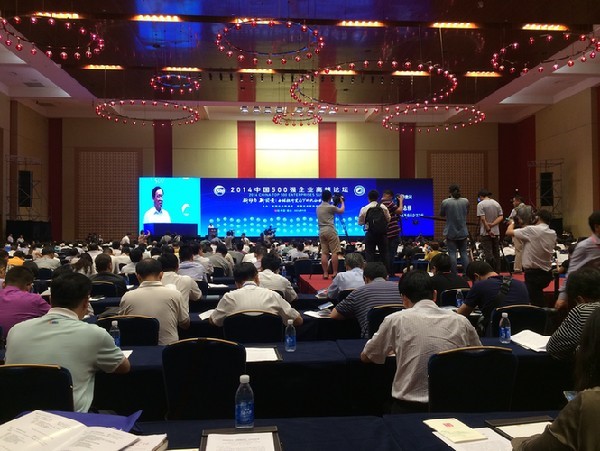
The 2014 ranking of China's top 500 enterprises is released on Sept. 2, 2014 in Chongqing, at the Top China Corporations Summit. [Wang Zhiyong/China.org.cn]
Recently, the 2014 ranking of the Top 500 Chinese Enterprises was unveiled by the China Enterprise Confederation (CEC) and the China Enterprise Directors Association. The top 10 in terms of revenues include three oil companies, four state-owned banks, State Grid, China Mobile and China State Construction Engineering Corporation. The revenues of the top 10 arrived to 12.7 trillion yuan, accounting nearly 1/4 of 2013China’s GDP. Moreover, the total assets of the 17 banks on the list is 107.3 trillion yuan with net profit amounting to 1.23 trillion yuan, respectively accounting for 60.8% and 51.0% of various total amount of the top 500 enterprises.
Why can banks and energy companies make so much money? Though SOEs reform since 1998 led to the decreasing state-owned enterprises and the increasing private companies, SOEs still command a monopoly. Contrary with the phenomenon of the private sector advances, the state retreats in overall industry, systematic SOEs are getting stronger and stronger while private enterprises are getting weaker and weaker in key and fundamental industries, such as oil, electric power, mining and other industries. In these industrial chains, SOEs usually dominate in the upstream and private companies compete with each other in the downstream. For example, Sinopec and PetroChina as the Top 2 are integrated vertically and have absolute monopoly in oil exploration, refining and retailing. State Grid, ranking third, has absolute advantage in power transmission and distribution rink. It has only one rival – China Southern Power Grid, and has been permeating into the upstream in recent years and becoming more and more integrated.
The bank is no exception. By the end of June this year, the assets of banking industry accounted for more than 90% of the assets of financial industry, among which the five state-owned banks occupied 43% of the total assets of banking industry. This means that the total assets of the five state-owned banks accounts for about 40% of the financial assets of the whole society. However, the Ministry of Finance and Central Huijin Investments have controlled ICBC, ABC, BOC, CCB and CDB with absolute advantage (over 65% shares), as well as Bank of Communication and Everbright Bank of China as the first majority shareholder. This means that more than 50% of China’s financial assets are controlled by the Ministry of Finance and Central Huijin Investments.
Central Huijin Investments was formerly regulated by the Central Bank and now is transferred to be a subsidiary of China Investment Corp which is funded by the Ministry of Finance and whose chairmen all have background of the Ministry of Finance. It means that Central Huijin Investments and the Ministry of Finance are persons acting in concert. This kind of control by state-owned element on financial institution is far more than the stock rights formerly scattered in various ministries. Therefore, though the state-owned element has nominally systematic decline (measured by shareholding ratio) in financial field, actually its control on financial industry is on the rise (the state-owned capital has leveraged more financial assets with lower lever). Doctor Lu Lei from the Research Bureau of the Central Bank pointed out that we can say without exaggeration that more than 150 trillion of total assets of banking industry can be all identified as state-owned assets.
This kind of distorted market pattern makes the competitive industry in downstream have no competitiveness when negotiating with the upstream industries about price and become the price taker. At this time, the state-owned element controls the production factors or channels having absolute monopoly and has monopoly economic rent. It carries out monopoly price over the upstream and downstream competitive private enterprises and consumers. Therefore, no matter how competitive the private enterprise is, it has to be trampled at key elements; and no matter how high its profit is, the profit will be eroded by the monopoly state-owned enterprises in upstream. The essence of China’s economy becomes private enterprises and consumers working for the state-owned enterprises. This explains why the top three of 500 enterprises are PetroChina, Sinopec and State Grid and why the profit of 17 banks accounts for half of the top 500.
If the market can keep prosperity, all participants would make profits from economic growth. However, the absolute monopoly position of state-owned element in core and fundamental industry make the main market’s operation assume consistency and the market has no hedging object at all. This means that the risk can not be transferred. Once the market situation gets bad, there will not appear the situation where one bank gets bankruptcy while the others keep intact, and one oil company appears deficit while the other makes profit. This means that bankruptcy of one enterprise may be collapse of dozens of enterprises, local risk in financial industry is systematic risk and most organizations have no possibilities of remaining intact while others are suffering. Seeing from the current economic situation, this kind of sign has become very obvious.
The 3rd plenary session of 18th central committee pointed out “to let the market play a decisive role in resource allocation”, but the diversified market competitive subjects are the precondition for the market to play a role. Single competitive subject and dominating state-owned element mean that the relationships among party committee and chairman, operating agency and regulatory bodies, regulatory bodies and contributors are never to be straightened out. This is the biggest problem of China’s economic activity. There is no doubt that to reduce the shareholding ratio of state-owned element in key and fundamental industry and split especially large central enterprises is a road that we must to walk on if we want to crack the dilemma of “all money is earned by state-owned enterprises and banks” and solve the problem that middle and small-sized enterprises and private enterprises have difficulty in making a living.
Published in Southern Metropolis Daily | 2014-9-4


