

The challenge of BRICS’ emergency reserve fund
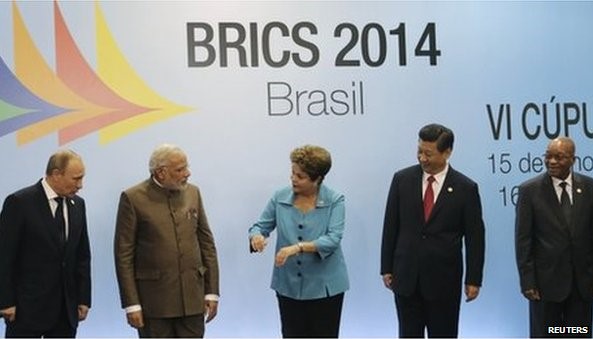
(Russian President Vladimir Putin, Indian Prime Minister Narendra Modi, Brazilian President Dilma Rousseff, Chinese President Xi Jinping and South African President Jacob Zuma)
The leaders of BRICS countries (Brazil, Russia, India, China and South Africa) have signed a deal to create a new $100bn development bank and emergency reserve fund. The fund which was announced as a "Contingency Reserve Arrangement" (CRA) will also have $100bn, and will help developing nations avoid "short-term liquidity pressures, promote further BRICS cooperation, strengthen the global financial safety net and complement existing international arrangements".
However, there are still a lot of difficulties for CRA being as the lender of last resort for the BRICS in time of crisis: First question is whether the CRA is able to meet the emergency bailout demand. The latest FOMC meeting in late June showed some signals that the US is expected to quit QE around October of this year. If so, the BRICS will face the crisis afterwards which may burst in the upcoming one or two years. The CRA designed to be the lender of the last resort is far more than money injection. Issues such as how to design the rescue system, how to layout the structure of the organization and how to recruit management staffs are all of great importance and in need of careful deliberation. However, presently, all these are quite demanding for the BRICS countries which have not been able to dominate the international financial system.
The second question is that we can’t estimate the severity of the financial crisis for now. But simply, a certain size of the rescue fund is absolutely necessary. Take China for instance, the foreign currency reserve has reached as high as $ 4 trillion, of which, a considerable part has become the capital of long-term foreign investment for China Investment Corporation and the State Administration of Foreign Exchange. Once there is capital flight risk, tens of billions of dollars is far from enough to handle the problem. In additional, although global payment imbalances of countries like Brazil and India are not as bad as China, the capital influx for recent 3 or 4 years is quite worrisome. Looking back to the IMF in the Asian Financial crisis, we can find that for Korea, one country only, the IMF rescue plan was up to $ 55 billion. From this perspective the current $ 100 billion contribution pledged by the five countries of BRICS may be too little, not to mention that whether each member country can fulfill their promise of contribution is still a question.
The biggest problem for current BRICS CRA is how to strike a balance. In international cooperation, the balance of rights and obligations is critical and the rescue normally provided for countries in crisis is hardly unconditional. During the Asian financial crisis, while getting funds by IMF rescue packages, Korea was at the same time forced to reform its policies in terms of domestic financial system and the capital account control and alike. Recipient countries and the international community have always been critical about this. Some even think that these additional conditions contrarily had worsened the crisis.
And this problem is what the BRICS CRA will confront. We should know that the cooperation between BRICS countries is not so much. We’ve seen a lot of cooperations among the BRICS countries, but large-scale and long-term actual cooperation project experience is still in lack. Moreover, internal problems existed within each BRICS country are also complicated, thus, mutually trust and mutual benefit in terms of cooperation between BRICS countries is not like that easy.
Published on China Times | 2014-7-18


