

Don’t Read Too Much into PPP Ranking
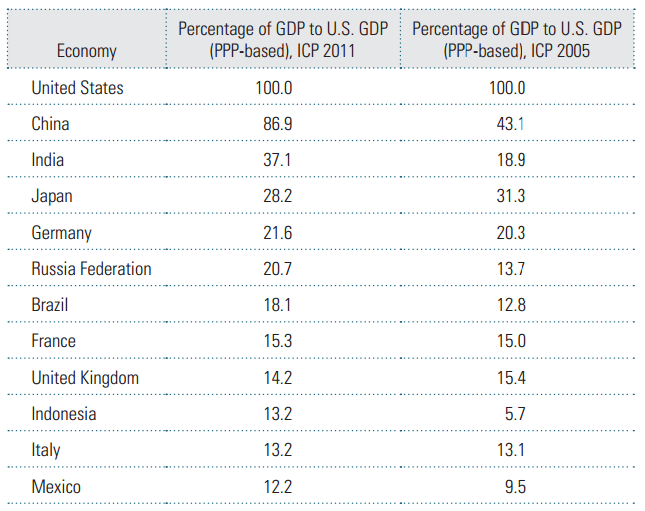
Percentage of GDP to U.S. GDP (PPP-based) for 12 Largest Economies, ICP 2011 and ICP 2005
(Source: http://icp.worldbank.org/)
The International Comparison Program (ICP), a project coordinated by the World Bank, released a new report with data suggesting that the size of the Chinese economy, by the measure of purchasing power parity (PPP), will surpass the US to become the biggest sometime this year.
How to compare the size of different economies? As we know, using their adjusted GDPs for difference in purchasing power is better than directly comparing GDPs at the violating exchange rate. The Big Mac index is the most popular application of PPP measure for estimation the real cost living through its different price in countries. According the latest calculation, the true currency exchange rate is 3.59 while the nominal is 6.26 now. Besides, there’re other indexes like Tall Latte index and Coca-Cola index.
Obviously, there has great difference in ranking by comparing size of economies with calculations based on market exchange rates and PPP. The Indian GDP in 2012 arrived $ 4.79 trillion in PPP terms, 156% higher than the number of $ 1.87 trillion calculated by the exchange rate. Almost all developing countries with large population, their real exchange rate is undervalued.
To some extent, PPP-based calculation solves the problem of undervalued currencies. Though ¥16.6 can be only exchanged for $ 2.65, you can buy the same Big Mac in China that worth $ 4.62 in U.S. If we could collect enough data of consumption categories, PPP-based calculation would be more accurate.
However, except for three organizations including the World Bank, IMF and the U.S. CIA systematically calculating adjusted GDPs with PPP, there are not so many economists who take these measures very seriously.
Why PPP calculation is not popular? Because PPP-based calculation assumes that people in different countries have the same consumption baskets, which led to deviations. More importantly, assessing the competitiveness of tradable sectors is the most important point for international comparisons. With adjusted GDP with PPP, China’s competitiveness will be overestimated. In fact, there are a lot of non-tradable sectors and barriers in trade sectors in our economy. Even China's adjusted GDP has surpassed the U.S, its imports from U.S won’t increase. The forthcoming No.1 just means a paper wealth, and we should not read too much into PPP ranking.
Published on Xinmin Weekly | 2014-5-12


