

The effectiveness of local governments’ assets
Over the years, China’s local governments take large-scale investments with expanding debts and then accumulated their assets. When many people analyzing the debt sustainability of local governments, they emphasize these local government debts are different from that of developed countries—governments in China borrow money for construction and gain assets while debts in developed countries are mainly used in social welfare. However, whether the assets formed by borrowing are effective?
Such effectiveness can be analyzed from users (the whole society) and the operator (the government).
Viewing from the social angle, the effectiveness of assets based on local governments’ borrowing lies in its adaptability with the economic development. Since infrastructure capital and productive capital can be substituted for one another, one judgment measure is to use a marginal productivity ratio between the former and the latter to determine whether infrastructure investment has been efficient. A ratio of 1 is efficient; a ratio above 1 shows an infrastructure shortage, while a ratio below 1 shows that further infrastructure investment will not be efficient.
According to such a standard, the research finding of Huang Shaoqing and Shi Hao of Shanghai Jiao Tong University indicated that in 1997 China was in obvious infrastructure shortage. After 1998, China’s government has invested the infrastructure on a large scale, and the marginal productivity ratio of infrastructure to productive facilities has dropped sharply in the following 5 years to nearly 1, indicating that the mismatching degree between infrastructure and productive facilities has remarkably lowered. In the following 10 years, the infrastructure investment dominated by China’s government continuously expanded on a large scale. By 2008, China no longer had a serious overall problem with insufficient infrastructure, and even had an excess of infrastructure in undeveloped areas.
After 2008, all local governments have still increased infrastructure investment, especially for western provinces where the marginal output of infrastructure was rather low and “the west development” policy was promoted, the situation of surplus infrastructure have been further worsened.
If we view the problem from the angle of asset operators, whether local governments’ investments are worth for their money depends on if the cash flows generated by the related assets is enough to cover the principal and interest. From local governments’ investment statistics, the maximal investment of the debts of local governments is on municipal construction, and the second is on transportation facilities, and the third is on land purchasing and storage. Except for land purchasing and storage that (might) have the self-liquidating nature, other investments are hard to generate the return rate that can cover the cost of funds.
The investment fields of local governments’ borrowing
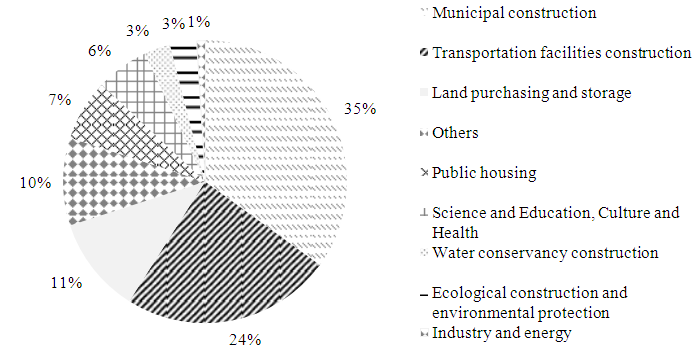
Many projects (such as subway) are useful assets for the society, but for the government, the cash flows generated are negative while government must maintain the operation of these infrastructures. From this point of view, these assets would rather be regarded as the liabilities of the government.
On the whole, the return rates of the assets formed by local governments borrowing are not high. China International Capital Corporation Limited (CICC) has extracted the data from 923 local government financing vehicles (LGFV). The total assets of these LGFV in 2012 were about 28.5 trillion yuan, and the gross liability was about 16.2 trillion yuan. As the weighted lending rate in 2012 was about 6.9%, CICC found that in 2012 the cash flows operated by LGFV were only enough to pay half of the interests, and the ratio of unsustainable debts was about 70.6%. If government subsidies were cut to these LGFV, the figures will be much gloomy.
Of course, the assets operated by some local governments themselves are not enough to generate many cash flows, but through supporting the economic development, they may be embodied as the raise of governmental fiscal revenue. Considering this point, the risks of LGFV ultimately depend on the debt repayment intention and the ability of gaining external financing supports. Therefore, CICC uses the index of “the cash solvency ratio” (cash/ principal and interest matured in the next one year) for reassessment. If such index is lower than 40%, then all the interest-bearing debts of the LGFV are affirmed as unsustainable. The calculation result indicated that in 2012 the amount of the unsustainable debts for the sample LGFV was about 1.7 trillion yuan, and the ratio was about 16.3%.
Therefore, according to the calculations with different standards, the unsustainable proportion of the debts of local governments is between 16.3%-70.6%. Naturally such an assessment will fluctuate with the fluctuation of the economic situation. But once China’s economic growth rate is going down, the unsustainable debts proportion will rise. In the future, the problem of sustainability for the debts of local governments will have a significant impact on the operation of China’s economy.
Published on Capital Week | 2014-4-20


