

How to define China’s real estate bubbles?
As we all know, the real estate plays a rather important role in China’s economy. Are there any bubbles existing for China’s real estate? What are the house property bubbles? The answer of this question may determine the future of China’s economy.
There are many evidences for the abnormally high China’s real estate prices which can also gain the supports from data. With regard to the trend of the nearly 3 years, viewing from the investigation data of China Real Estate Index Academy on the housing prices in one hundred cities in China, the average housing price of the one hundred cities raised from 9,042 yuan in June 2010 to 10,960 yuan in February 2014, going up 21%; while for the first-tier cities (Shanghai, Beijing, Guangzhou and Shenzhen), the price raised from 20,799 yuan to 28,563 yuan, and the growth rate was as high as 37%. According to the secondary housing price index from Centaline Group Research Centre, the selling price of the second-hand house in Shanghai reached 38,191 yuan in February 2014, even higher than that of the new house of the Index Academy, and this is mainly due to that these second-hand houses include more houses with better locations.
According to the data of the National Bureau of Statistics, the per capita disposable income in Shanghai which is the city with the highest per capita income is 43,851 yuan. According to the family size of 2.35 persons for calculation, the family disposable income is about 103,500 yuan. According to the per capita housing area of 33.9 square meters, even the value is calculated according to the rather lower price level of the Index Academy, the value of single set of house in Shanghai is 2.275 million yuan, and the housing-price-to-income ratio is as high as 22 times. If the ratio is calculated with the higher Centaline index, it is as high as 29.4 times.
Viewing from any standards, such a numerical value is too high, and the house price data website numbeo.com has provided more proofs. With the way of big data and based on the information sources from 138,000 volunteers and the Internet, the website collects the house prices and income data of all cities in the world, and calculates the house prices and income of all cities in the world. The result displays that in 158 countries, China’s housing-price-to-income ratio ranks No.11. The countries prior to China are famous high housing price city states such as Morocco and Hong Kong etc., or the countries with little data reference degree such Burma and Cuba etc.. Viewing from the housing-price-to-income ratio, China’s real estate prices are undoubtedly very high.
But under the circumstance of the high housing prices, the booming development of China’s real estate is an indisputable fact. The explosive development of China’s real estate market is more embodied in its huge scale, and the whole China almost has become a construction site with continuous construction for 20 years. In 2002, the sales area of commercial housing was 250 million square meters, and the sales amount was 0.57 trillion yuan. By 2013, the sales area of commercial housing reached 1.3 billion square meters, and the sales amount even reached the surprising amount of 8.14 trillion yuan. By contrast, the total amount of social retail in 2013 was 23.44 trillion yuan, and the ratio of the sale amount of commercial housing to the total amount of social retail exceeded 1/3.
Even if China’s housing-price-to-income ratio ranks among the front row in the world, it’s hard to say that it has somewhat risen than that of 10 years ago —— in fact, many data series all display that the growth rate of housing price is actually slower than the growth rate of per capita income. For example, according to the calculation by the ratio of the sales amount of the national commercial residential buildings to the sales area of the commercial residential buildings, the average selling price of commercial housing raised from 2,026 yuan in 1998 to 6,237 yuan in 2013, raising by 2.1 times, but the per capita GDP in the same period raised from 6,796 yuan to 41,805 yuan, raising by 5.2 times, and the annual average growth rate was 7.8% and 12.9% respectively. Viewing from Shanghai, the first-tier city with more rapid growth rate, the housing price calculated by the same caliber raised from 5,118 yuan in 2003 to 14,061 yuan in 2012, and the annual average growth rate was 10.6%. According to the investigation display of Southwestern University of Finance and Economics, the price for the first set of house owned by resident has raised by 340%, supposing that the data were collected between 1999 to 2013, then the annual average growth rate was 12.1%. If we guess reasonably, the annual average growth rate for the housing price of the whole country should be between 10.6% to 12.1%, and the evaluation of the intermediate value is 11.4%. In this way, the housing price annual average growth rate actually is slightly slower than the per capita GDP growth speed of the whole country.
The above data tell us that sharp rise indeed has appeared for China’s real estate price, but it’s hard to say that the housing price raise speed is faster than the per capita GDP growth speed. In other words, the great development of China’s real estate market to a large extent is supported by the rapid expansion of the resident income. With the rapid growth of economy, it has the economic rationality that the residents become rich rapidly and they allocate the corresponding proportion of their increased income on housing; while the great development of the real estate market has also constituted an important component of the national economy, and vice versa, it contributes to the fast growth of economy.
Therefore, in the sense that the housing price gains the primary surface support, it’s hard for us to declare that bubbles have appeared for China’s real estate. However, this is just one aspect of the problem, if we define the asset price bubbles as being unable to maintain the price level, then whether bubbles have appeared for China’s real estate market is still worth further discussion.
On the one hand, houses have the nature of consumer goods, in the case of income raise, the funds allocated on house consumption raise, supporting the housing price raise; on the other hand, houses have the nature of investment, and without exception, in all countries, they are the biggest part of the assets of residents. The buying and selling decision making for a house is influenced by the consideration for the future return on investment of the asset. China’s real estate prices maintain a high level of the highest income ratio in the world. With regard to the investment decision making, investors believe that such an investment can bring about good enough return of investment. According to the classic thinking of the discounted cash flow model, the price paid by an investor must be worth of his estimated value of the investment target, and such estimation is established on the prediction for the economic growth rate in the future. Based on such thinking, I have calculated the economic growth rate expectation implied in the housing- price-to-income ratio of all the countries above, and the result can be seen in the following figure:
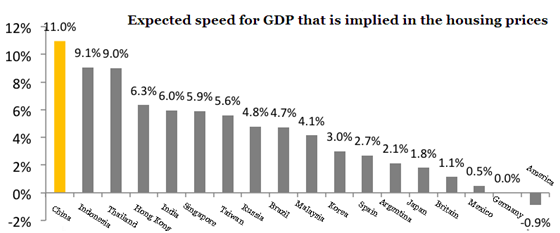
The research indicates that housing prices in Asian countries are generally rather high, and its implied economic growth expectation may be too high. For example, the rate is above 9% for Indonesia and Thailand, above 6.0% for Hong Kong and India, and 5.6% for Taiwan. By contrast, the expectation value for Germany, Mexico, Britain and Japan is very low. But the housing-price-to-income ratio of America is the highest, and accordingly the implied economic growth expectation is the lowest. The country with the highest rate is China, and the implied economic growth expectation reaches 11%.
If China’s economic growth rate can reach such a speed in the future, then the current housing-price-to-income ratio is reasonable and sustainable, otherwise, such a numerical value is too high, representing that such an investment may fail to gain the qualified rate of return. Therefore, for the disputes on whether China’s housing prices have bubbles, the answer depends on whether China’s economic growth rate can maintain the current superspeed.
In history, the housing prices in Japan also once raised sharply before the 1980s, but the implied economic growth rate was not higher than the actual achieved economic growth rate, so such a situation supported the raise of the housing price in Japan. After the 1980s, the housing price in Japan once again soared, and the implied economic growth rate expectation was as high as around 8%. But with the situation that Japan’s economic growth rate was far away from the expectation, Japan’s housing price declined sharply soon afterwards.
According to our calculation, in the future 10 years, China’s economic growth rate may be lowered to the range of 5% to 5.5%, and the nominal economic growth rate may be lowered to the range of 7% to 7.5%. If the situation is really like that, then the housing prices are hard to be maintained at such a high housing-price-to-income ratio, and the investment demands for houses will be lowered, then the real estate market activities will be cooled. And such a change will urge the economic growth rate to decline, further denying the investment reason of maintaining high housing prices.
Published on www.ftchinese.com | April 25, 2014


