

How important are the products like Yu’e Bao
(Source: Huxiu http://huxiu.me/)
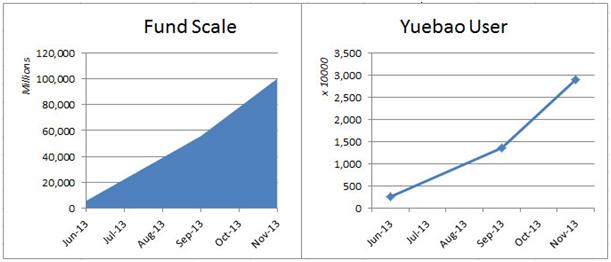
No one ever thought about that the online financial-services product “Yu’e Bao” issued by Alipay jointly with Tianhong Fund on June 13, 2013 triggered such a big reaction. By Yu’e Bao, Tianhong Fund rises from a no name to the top in the industry on January 15, 2014. Moreover, various wealth management platforms similar to Yu’e Bao have been emerging one after another, for example, “Licaitong” launched by Wechat attracted 800 million yuan on Jan 22, the day it was launched.
How should we look upon these wealth management facilities like Yu’e Bao? Though with great development, many people in the traditional financial institutions believe such products can’t go far beyond, just like the final shutting down of the PayPal Money Market Fund in 2011.
Perhaps China’s future various money funds will have the same fate as the U.S. money funds, but it is the matter in the future. For financial institutions such as banks, the most urgent challenge is to slow down the transferring from retail deposits to online wealth management platforms. As a result, they have offered two measures:
1\ Set the maximum transferred amount in a single day. Taking Licaitong as an example, in the public testing stage, the transferring limit for each bank is 8,000 yuan. After being on line officially, the limit for each deal is increased to 50,000 yuan, and all banks have provided different limits from 5,000 to 500,000 yuan. However, such limits are meaningless. Because users of Licaitong are mostly the clients who have been ignored by traditional wealth management products -- certain thresholds are set for all traditional wealth management products and the minimum is at least 50,000 yuan. Moreover, this has shown the worries of banks from another side-- because the 7-day annualized return rate of Licaitong hit 7.394%, which has already approached many trust product earnings aiming at high net value clients.
2\ Raise bank deposit interest rates and release corresponding wealth management products. According to reports, China Construction Bank delegated in mid-January their first-tier provincial branches to hike the interest rates under the floating-rate scheme, even allowing the latter to further delegate the power to their subordinate city-level branches. In another word, to attract deposits, many state banks have recently raised their deposit interests to a level 10% higher than the official rate, the maximum permitted by the floating-rate scheme.
There is a medium saying that “all banks are observing the fund flow and the estimated funds flowing to the Internet financial sector by the middle of 2014 will reach one trillion.” But the raise of deposit interest rates is also a double-edged sword for banks. Because China’s banking earns money from the spread between the deposit rate and the lending rate, once the bank deposit interest rates are raised, it means that the profits of banks will be swallowed.
What is interesting is that since the central bank has reduced interests asymmetrically and allowed the maximum raise of 10% for deposit interest rates on July 6, 2012, some urban and commercial banks and stock-holding banks all “raised the interest rates once to the top.” But for the five major traditional state-owned banks, including ICBC, ABC, BOC, CCB and BOCOM, they haven’t raised the deposit interest rates to the top. With the advantage of a huge amount of depositors and networks, they enjoy more scale advantage than stock-holding banks and urban and commercial banks. But no one ever thinks about what has forced them to raise interest rates are from the savages from the outside of the financial industry, such as Yu’e Bao and Licaitong.
Then, does it mean that the wealth management products of these internet platforms will bring better investment returns? It is so at least viewing at present. Compared with the demand deposit interest rate of 0.35% set by banks, the annualized return rate that frequently reaches 6% is very attractive. However, the biggest significance for those online wealth management products is not the higher return but the change of the financial ecological environment in China. The bank credit has always played a key role in China where the indirect financing is dominant, and the profits of banks are also far higher than the average level.
Gao Limin and Nie Riming who are my colleagues once described China’s banking with the words of “credit and loan ark” effect. It refers to that those people who are capable of gaining credits and loans (those people who get on the ark) are more easier to get rich, obtain more development opportunities and can share more bonuses of modernization; but for those people who fail to gain credits and loans (those people who fail to get on the ark) are hard to share the bonuses of modernization, and they also have to provide financing supports for those people who get on the ark. In other common words, it refers to that the current bank credit and loan pattern lets the poor deposit money which is used by the rich. Under such a pattern, the Mathew Effect that the poor become poorer and the rich become richer.
However, the appearance of products such as Yu’e Bao has completely changed the phenomenon. The convergence of a huge amount of small clients can thus generate the market energy that is equal in force with the mainstream. Taking WeChat payment as an example, according to the disclosure of the third quarter financial report of Tencent in 2013, the amount of the monthly active WeChat accounts reached 271.9 million. This is the peak that not a single bank in China can achieve: though ICBC serves the largest client group in China, there are only about 100 million individual clients and 8.1 million corporation accounts.
So many long tail clients aggregate, and the operation costs of banking have been directly raised, maybe the matter that several generations of economists have always appealed but the decision makers have failed to achieve can be accomplished--interest rate liberalization. This may be the biggest significance of various online wealth management products for China’s financial market. Many years later, when China realizes the interest rate liberalization, the merit should be recorded for the founding of Yu’e Bao on June 13, 2013.
Published on Tencent Dajia Column | 2014-1-25


