

Megacities with 50 million people in China?
In order to prevent city diseases, the Third Plenary Session of the 18th Central Committee of the Communist has put forward the opinion of “strictly controlling the population scale in megacities,” but the problem is that can the population scale of megacities really be controlled through administrative means?
The past experiences have told us that such a practice is unfeasible. Taking Shanghai as an example, the Urban Overall Planning Scheme for Shanghai City in 1986 regulated that the population of the whole city should be controlled around 13 million in 2000, but in the fourth census in 1990, the population already reached 13.34 million, realizing the planning 10 years in advance. In the Urban Overall Planning for Shanghai City (1999-2020) in 2001, it regulated that in 2020, the total population will be about 20 million, and as a result, at the end of 2009, the population was over 20 million. In the “sixth census” in 2010, the population even reached 23 million. In fact, such a situation is not the phenomenon that only happens in Shanghai, it is so in all megacities. Of course, actually the population in some middle-sized and small cities is reducing.
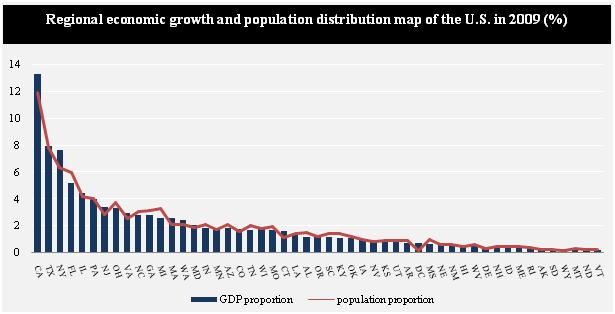
Then what amount of population should be reached in Shanghai? Let’s firstly see the following regional economic growth and population distribution map of the U.S. in 2009. In the map, the columns represent the GDP proportions of all states, and the line represents the proportions of population in all states. We can find a very interesting phenomenon. Except in Washington DC where the GDP proportion exceeds its population proportion far beyond, and in other states, the two proportions are roughly equivalent. For the GDP top five states, their GDP occupies 38.61% of that of the U.S., and their population occupies 38.24% of that of the U.S..
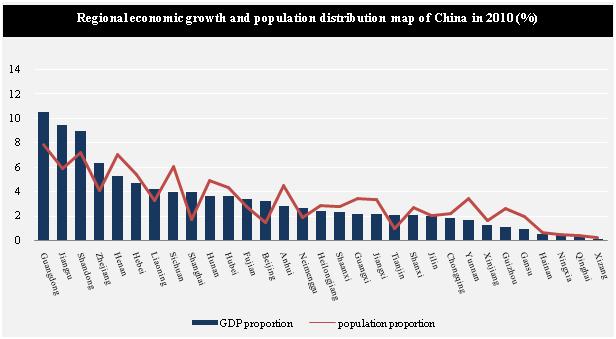
If we look at the regional economic growth and population distribution map of China’s various provinces and autonomous regions in 2010, we can find that the situation is totally different. In this map, except Hainan, Ningxia, Qinghai and Tibet, the GDP proportions in China’s provinces and autonomous regions do not match with their population proportions. For the GDP top five provinces, their economic aggregate occupies 44.43%, but the population only occupies 31.81%.
Why there is only the difference of 2% for the GDP and population proportions for the top five states in ranking in the U.S., but in current China, there is the difference of 12%? The past explanation was that the production efficiency in these several provinces was extremely high, and they created more economic outputs with less population. But the question is, people are rational, and they will go to the place where they can earn more money. Why the GDP and population proportions are matched in all states of the U.S., but in China, there is such a big difference? The biggest possibility is that there are too many barriers restricting the free flow of population.
Taking Shanghai as an example, in 2012, the GDP of Shanghai occupied 3.87% of that of the whole country, but its permanent resident population was only 23 million, occupying 1.72% of the population of the whole country. If its population proportion is going to be matched with the GDP, then even if the permanent resident population reaches 50 million, the proportion only occupies 3.7%. In other words, the current population of 23.8 million in Shanghai may be far from its peak.
But worries maybe arise: How can the current crowded Shanghai absorb another 25 million people? In fact, we do not have to worry too much. Taking Tokyo of Japan as an example, the Tokyo metropolitan area is 13,400 square kilometers, smaller than Beijing of 16,800 square kilometers. But the population of Tokyo metropolitan area of is about 35.676 million, occupying about one third of Japan’s population while the population of Beijing is only 20 million. However, at least viewing currently, the transportation and environment of Tokyo are all better than those of Beijing.
Viewing from this point, how much population that one city has is not the problem, what is important is the governance ability of a city. Then, should we let the urban governance ability improve with the increase of urban population, or should we deceive ourselves by trying to control the urban population scale? If the governance ability is upgraded, then it’s no wonder that a megacity with the population of 50 million appears in China.


