

The foolish attack to Starbucks
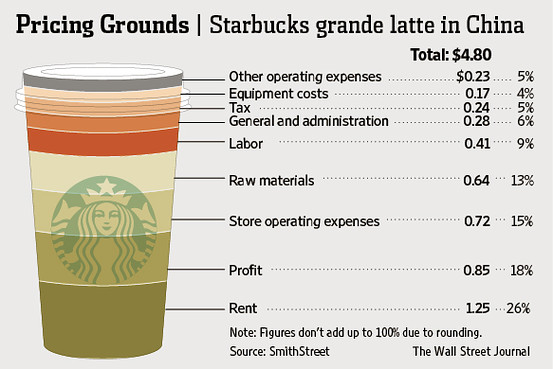
In the consumption time, the criticisms by media on saying that something has huge profits have always been welcomed by readers, especially in the current China. After Apple, Starbucks was fiercely attacked by official Chinese media for its high prices. Their investigation pointed out Starbucks’s huge profits: The material cost of a cup of Starbucks U.S. style coffee is only 2.6 yuan, but the selling price is 25 yuan. Besides the high selling prices, another blame is that a mug with marked price equivalent to 66.7 yuan in Starbucks shops in Seattle of the U.S. is sold in China at the price of 100 yuan.
Fortunately for Starbucks, there is no lack of fellow sufferers also being criticized by media. It is not rare that the glasses industry has been criticized again: the factory price of a spectacle frame of Levi’s is 170 yuan, the wholesale price rises to 550 yuan, and the retail price is above 1,000 yuan. Even the vendors by roadside who paste film have also been criticized: the wholesale price of one piece of film is several yuan at most, but it costs dozens of yuan for pasting one piece of film by roadside.
The criticisms by media seem to be reasonable, but they have violated the common sense of ordinary people: could the vendors by roadside also enjoy huge profits? The counterattack follows: “since there are thick profit margins, why don’t reporters open glasses stores?” Behind such simple query, there are profound principles of economics.
Firstly, even the common people also know that the composition of costs does not only include materials. Today when the prices of land have risen increasingly, in the prosperous commercial districts in the first-tier cities, the property rents are very high, occupying a very large proportion in the costs. Besides, the decoration, labor cost, water, electricity and gas fees in the daily operation and taxes etc. have all constituted the costs of products. How can the media only calculate the profit rates only by material costs? The vendors who paste film in the streets have to endure the intense heat of summer and cold wind in winter, isn’t it a kind of great human cost expense? In fact, how much costs are not important. In the market, scarcity instead of cost determines prices.
Influenced by the orientation of Starbucks for serving the public in the U.S., the business environment of Starbucks in China does not appear to be so good. Usually there are many people, so it is unavoidable that it’s crowded and noisy, maybe one table has to be shared by several persons, so people have to “actively” exchange their privacies in their talks. Even so, the special meaning brought by “drinking in Starbucks” still attracts many people who are willing to go there to read books and discuss problems. From another angle, it also shows that people go to Starbucks not just for drinking coffee or drinking coffee comfortably, but for realizing a kind of identity. As time passes, such a kind of behavior has been changed into the consumption behavior of collective unconsciousness that is special for a certain consumer group. However, this has further strengthened the function of identity recognition and status symbol for “drinking in Starbucks.” This is of course the strength of a brand.
As the saying goes, first-class enterprises sell standards, second-class enterprises sell brands, and third-class enterprises sell products. In fact, what Starbucks provides is a kind of cultural experience, what it sells is a kind of identity standard identification. This has determined the scarcity of Starbucks, and it has further determined its market position and the high pricing capacity that is brought naturally by such a position. In short, this is the strength of a brand. But the brand power is just a tip of an iceberg, what is under the water is more profound. Viewing in essence, what Starbucks sells is a kind of cultural experience which is rooted in a stronger culture. A strong culture will cause a brand to generate a high-end sense, for example, when McDonald’s just entered Beijing, someone regarded it as a top grade restaurant and chose to hold a wedding in it. But a strong culture itself is not something being created out of nothing, it is rooted in the strong products and technologies. When space shuttles, Iphones, INTEL and WINDOWS have been sold well all over the world, the coffee brand of course contains a special meaning.
As for different prices in various districts, it is indeed a kind of “price discrimination.” Simply speaking, the so-called price discrimination is that manufacturers sell the same products with different prices to people with different demands. The price discrimination generally exists in daily life, and is a kind of normal right of merchants. The selling of the binding of two bottles of coke with a cheap price is price discrimination; the free tickets or discounts that are given to local tourists by scenic spots are also price discrimination. But relevant media interpret price discrimination without real understanding and regard it as negative when seeing the word of “discrimination”.
It is undeniable that indeed there are few foreign brands exploit an advantage in China to seek abnormal high profits. But generally speaking, as long as one industry is open, there is no governmental power to set certain access thresholds, then basically, we may say that the prices of the industry are normal and reasonable. Though sometimes it is inevitable that some natural monopolies appear and cause some temporary monopoly prices, but in the long term, no one can always stand on the peak of technological monopoly. One example is that Microsoft was very influential ten years ago, but now it has been strongly challenged by Google and Apple Inc.
These are originally the basic knowledge of market competition, but it is regrettable that some media criticize huge profits in a grand style. The improper scolding for “huge profits” on a certain degree has exposed the lack of the common sense of the market economy for the critics.
However, does such official medial’s attack indicate the beginning of another campaign of rectification? Now the relevant governmental departments prefer to carry out a grey management, and such a management pattern often carries out rectification with uncertain or too harsh regulations. And in recent period, the rectification has been further intensified toward the direction of morality suppression by Populist public opinions.
The deeper level background is that some social ideology that is embedded in people’s minds has outweighed the common sense of the market economy. In current China, though the market economy has become the basic pattern of the society, but not the people’s belief and knowledge depended on of judging things. The negative understanding on the concepts of the so-called capital and exploitation etc. for long time has become the root for breeding the consciousness of Populism, and this is what we need to be strongly vigilant.
Originally published on Tencent Dajia column | 2013-10-22


