

Make government budgets more understandable
The budgeting democracy, i.e. the national legislative body carries out the supervision, review, balancing and audits for government budgets, is an important component of modern democratic politics. In a way, it is also an important marker of a modern country.
Viewing from the development history of western parliaments, to a great extent the reason why a parliament appears is surrounded by the supervision and balancing on how a government taxes and spends. And with the evolution, one major function of parliaments of western democratic countries is to supervise and control governmental budgets. There is a study that has found that legislative bodies of western countries (generally including Senates and Houses of Representatives) spend over 60% of the time on the audits and discussions of various government budgets.
However, how are government budgets made, and how to implement, supervise and audit? What are the related institutional arrangements? What are the institution settings in actual operation? What are the similarities and differences for the budget supervision systems of governments of various countries? For such questions, except few experts of public finance and politics, other common people know very little.
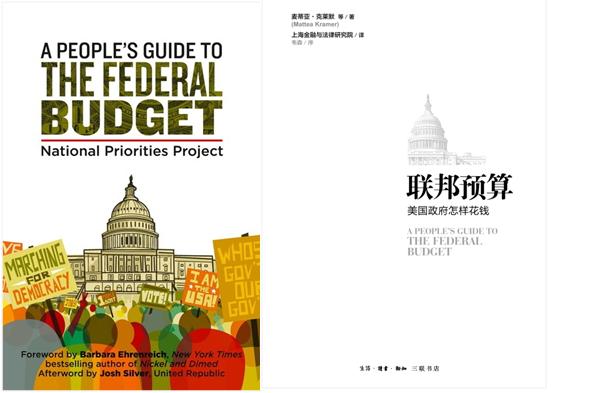
The book A People’s Guild to the Federal Budget: Chinese Translation Version (Written by Mattea Kramer et al/National Priorities Project, translated by SIFL Institute, and will be published by Joint Publishing in the near future), covers from history of the budget process to detail about the ongoing conflict in Washington, from charts explaining where every federal dollar goes to simple explanations of budget terminology.
In terms of understanding the U.S. politics and the operation of the governmental system, this is a very good reference book, and for the current China’s reforms of political structure, it also has a very practical referential meaning.
At present, China is in the key period of deepening reforms and social transformation. China’s reforms of political structure firstly should be the reforms on the government system and the construction of modern democracy and the rule of law. With the introduction of the market economy and economic development since China’s reform and opening up, currently the fiscal revenues and expenditures of Chinese government have reached more than ten trillion yuan. Under such a situation, the enforcement of the legislative body on the supervision, checking and balancing, control and audits on government budget has become the most important reform agenda for China’s reforms of political structure and the political construction of modern democracy and the rule of law.
In the report of the 18th National Congress of the Communist Party of China, when speaking of the premeditation for China’s reforms of political structure, the first article is that “the people are supported and guaranteed to exercise the state power through the People’s Congress.” It is also clearly put forward in this article that “the system of the People’s Congress is the fundamental political system that guarantees the people to be the master of its own affairs. We should support the People’s Congress and its standing committee to fully give play to the roles of the organs of state power...The People's Congress should strengthen its supervision on government, court and procuratorate, accounting exercise of the full-covered budget.”
The most important part in China’s reforms of the economic and political structures is the fiscal reform. And the most core component this reform lies in strengthening the supervision and audits from People’s Congress to government full-covered budget, and institutionally protecting the related institution settings.
In this sense, though it is market economy in China now, the National People’s Congress as the national legislature has not yet really supervised the government fiscal budget, which means that China is not a modern country. If this problem can’t be solved, the massive official corruptions continuously happen, and various social problems that are related to government financial powers constantly occur and accumulate. Therefore, putting into practice the first article on the reforms on political structure in the report of the 18th National Congress of the Communist Party of China should be an important task of the reforms on political structure in current China.
Under China’s current social pattern, reading the book no doubt has very important referential meaning for China’s future state institutional improvement. And for more than 1.3 billion Chinese people who act as taxpayers, this is also an unusual “book of enlightenment.”
At last, please allow me to imitate the words of the author of the book and make an appeal to you: “you, and all of the Chinese, should all more seriously understand the governmental budgeting process, and speak out your opinions when you feel that it can’t satisfy your requirements. After all, your voices and your actions are the most fundamental strength for pushing forward the reforms of the political structure in China.”
Originally published on cn.wsj.com | 2013-8-16


