

De-leverage in China
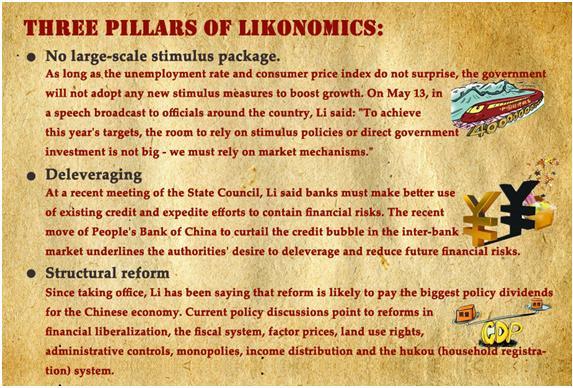
Barclays Capital has a word for Premier Li Keqiang’s plan for China’s growth: Likonomics. It stands for: no stimulus, deleveraging and structural reforms. Such wording has triggered wide attention, but it also triggered a question — what is a lever?
At present, the index that people use for describing the degree of China’s leveraging usually is “M2 to GDP,” and it is pointed out that in 2008 such an index reversed the downtrend from 2003 to 2007, and began to rise rapidly, therefore de-leverage is needed. But in the world, the ratio of M2 to GDP has never been used as the index of a lever, and this is because for M2 and GDP, one is stock, the other is flow, so they cannot be simply compared.
Generally speaking, “lever” mentioned in economics all refers to the asset-liability ratio, and the proportion of debts occupying in the composition of assets display on the balance sheet. Any economy is composed by balance sheets of four departments, i.e. government, enterprises, financial institutions and households. In terms of China’s finance, because its financial structure is the indirect financing with banks as the main part, so the financial lever that we usually understand refers to the bank capital adequacy ratio. And now, such ratio in China’s banking industry is the highest in the world, and even too high, also it is required that the percentage of the provision occupying the whole assets is no lower than 2.5% - this is the highest provision coverage in the world. Besides the state-owned enterprises, the debt burden of private enterprises also has not been excessively increased. Therefore such a concept also needs to be discussed profoundly on what departments on earth need to de-leverage. Observing from this angle, what with rather high lever ratio in China are the governmental balance sheets which are conspicuously displayed in the local debt burden.
More specifically, the current problem in finance is not de-leveraging, but the transparency of shadow banking. There are two solutions: One is that off-balance sheet activities (OBS) should be transferred to be on-balance sheet items with relevant regulations; the second is asset securitization. As the standard finance products thoroughly entering into the securities market, they can be transferred, bought and sold, thus the risks can be disclosed and diverse. Only promoting more transparency can we know how high the financial lever is.
At present the comments abroad mainly worry about the real estate bubble, and think that the lever is too high. In fact, the owned funds of the real estate industry is as high as 77%, the proportion of the down payment for real estate mortgage loans for residents is high, and the bad debt ratio is low, therefore the lever of the real estate sector is not very high.
The core problem for the real estate industry is that too high housing price has influenced the social stability. At present, the means of government on housing price control is the housing-purchasing restriction, but such an operation method seems to come to an end, and it needs to be changed over to new ways. The most important thing is to increase land supply but not the restriction on the buying demand. For example, the residential land in Beijing City only occupies less than 30% of the governmental land supply. Under the condition of ensuring employment, the industrial usage of land can be properly reduced, turning some industrial usage of land into residential land, then the supply areas of the real estate industry will be increased, and thus it will contribute to restraining the too rapid raise of the housing price. Viewing from the medium and long term, due to the development trend of urbanization, the real estate industry will exist for a long time as an important industry. In this sense, for the real estate industry, whether or not de-leverage should be carried out is not the problem, but the problem lies in how the industry is to develop.
What needs to pay close attention to is that the lever ratios of local governments and their financing platforms are really rather high. But the core of this problem is fiscal and taxation system instead of lever, i.e. can local governments incur debts and should they bear debts? This needs fiscal reforms. After the reform direction has been determined, firstly, in the sense of local financing platform, in theory the financing platform can be peeled off from local governments, turning the implicit guarantee of local fiscal resources into a state owned enterprise, and local debts become enterprise debts, thus it contributes to transparency. Besides, many projects have incomes, and they can help to repay debts. Secondly, in terms of local governmental debts, those local governments that have fiscal repaying capability can be allowed to issue municipal bonds. Because municipal bonds need to be repaid, it urges that local governments must establish their own balance sheets, thus their financial restraints are hardened by market disciplines.
Viewing from the angle of risks, the appearance of local debt problem even means that the reforms on the fiscal and taxation system admit of no delay. The enthusiasm of local governments on selling land this year is very high, the reason lies in the great influence of turning the business tax into the value added tax on the local fiscal revenues. Such reform would reduce revenues of local governments, and it causes that the impulse of local governments on selling land for gaining incomes has become even stronger. This also shows that the reforms on the fiscal and taxation system have become extremely urgent, only by establishing a more stable fiscal and taxation system, the situation can be improved. Compared with de-leverage, the structural reform is more worth to promote.
In conclusion, de-leverage can not accurately describe China’s current economic situation.
Originally published on ennweekly.com | 2013-8-9


