

More should do besides issuing new regulation about WMPs
On March 25, China Banking Regulatory Commission (CBRC) issued new regulations to control risks of banks’ wealth management products (WMPs). In its statement on CBRC website, commercial banks are required to reform WMPs’ poor information disclosure and opaque investment structures. Especially, banks should invest in “informal debt assets” at no higher than 35% of total outstanding WMPs, or no more than 4% of their total assets, whichever is the lower amount. After the issue of such new regulation, the stock market took a hit led by bank shares. To understand the strong market reaction, we should know the essence of WMPs.
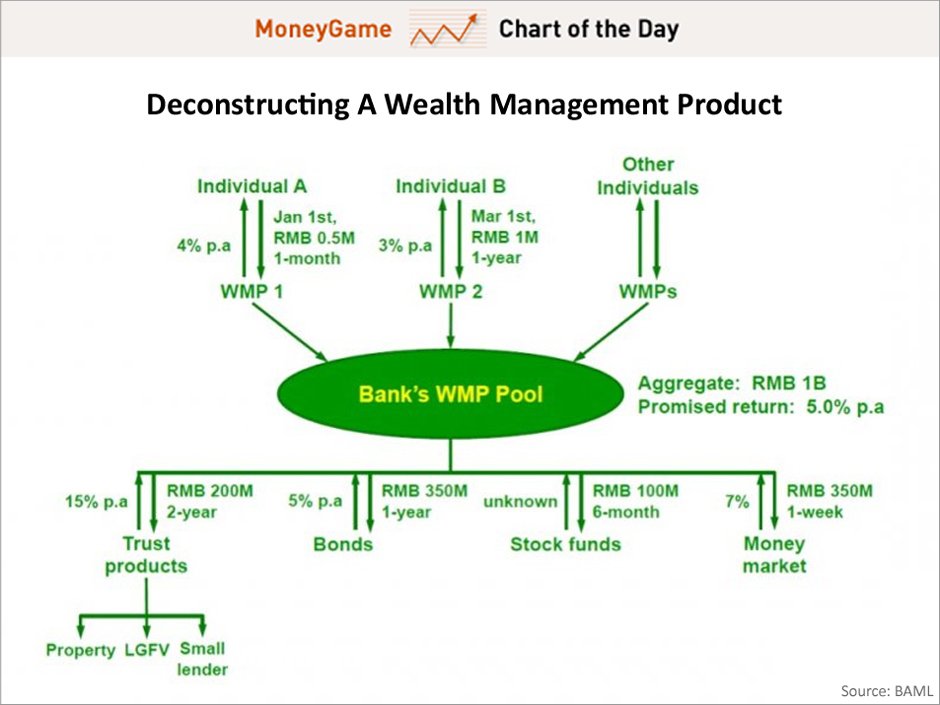
Essentially, WMPs are a pool of repackaged loans that have higher yield than bank deposits. Among them, some have principal or interest guaranteed, and some are directly backed by specific loan projects while others are vague about the source of their returns. Currently, commercial banks in China are backed by national credit guarantee, and their risks are systematic risks. But when banks sell the WMPs to investors, publics regard them as a safe substitute of deposits, ignoring the remarkably higher risks of WMPs than systematic risks.
On the surface, it seems an all-win situation. For borrower of funds, if the WMPs risks are reduced, the financing costs are also reduced; for investors, they can earn more interest than bank deposits; for commercial banks, they can raise funds by WMPs off-balance-sheet, where banks technically aren’t responsible to cover any related losses. However, under such a seeming all-win situation, systematic risks are rising and government bears more and more hidden debts.
Obviously, this is not what CBRC wants to see. The logic of CBRC is very clear, that is, identifying risk-sharing facilities. So here comes the new regulation about WMPs to prevent the country to pay the bill when there is something wrong.
However, to reduce risks of WMPs, can the new regulation work? The active opinions believe that the standardization of “informal debt assets” will promote banks’ formal debt business. In my view, it is of course no problem in a short term, but may not be effective in a long term. WMPs’ boom lies in China’s interest rate control and state’s implicit guarantee to banks. Once the fixed margin between deposit and lending rates still exists, there will be interest arbitrage and regulation arbitrage. And CBRC can’t stop banks’ such creation once they enjoy government’s guarantee.
Therefore, the essential solution faced by the Central Bank and CBRC is not well regulation to WMPs, but to promote the reform of interest rate liberalization. Before that, there is a more basic problem that needs to be solved: letting banks bear their own risks by themselves, and peeling off them from systematic risks. If this step of reform is not gone ahead, we must return to the time before the reform when intermediate business of bank operation was not allowed, and banks were tightly controlled and supervised, as long as the banks did not operate the business, they could be prevented from doing something wrong and the state could suffer fewer losses. Obviously, this does not conform to the direction of the current bank reforms.
In fact, the 12th Five-Year Plan for the Financial Industry issued in 2012 clearly indicated that, “the reform of market-oriented interest rates should be promoted orderly through the approaches like further liberalizing prices of alternative financial products.” And this is just the way that direct financing tools of WMPs, bond market and trust etc. have followed.
In a word, the CBRC’s new regulation about WMPs may be regarded as an expedient to prevent the impact of the fast expansion of bank financing on short-term systematic risks, so as to gain time for further bank reforms and interest rate liberalization.
Originally published on No. 118 issue of the 21st Century Business Review | 2013-4-12


