

What is the core competitiveness of Huaxi Village?
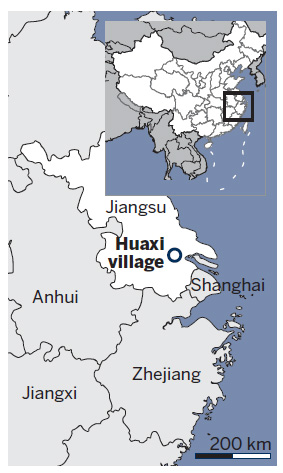
With the death of Wu Renbao, the old secretary of Huaxi Village, Huaxi Village has become a focus of attention of media and public again. How to understand the success of Huaxi Village is always a disputable topic. Some people call it the model of common prosperity, and others call it in name of being collective and being actually privately-owned: there are researchers who point out after carrying out statistics that the disposable available capital of four sons of Wu Renbao (the available capital is defined as net profit after deducting income tax) occupies 90.7% of the total funds of Huaxi Village.
Huaxi Village is a large empire. According to the reports of media, up to the end of 2012, the total unaudited assets of Huaxi Group exceeded 35.87 billion yuan, and the gross revenue of 2012 was 26.8 billion yuan. The business scope of Huaxi Group covers agriculture, industry, business and trade, and it owns 104 wholly funded and holding companies. Ironically, though Huaxi Village is widely known, few knows its core product— that is to say, everyone knows Huaxi is very rich, but no one knows what it relies on to get rich.
In my view, it’s Huaxi’s unusual financing channels instead of its products that make it rich. In current China that is transferring from planned economy to market economy, due to the underdeveloped financial market, financing is always a problem that puzzles the survival and development of small and medium enterprises. Why can Huaxi Village gain so many credit supports? It’s very important that Huaxi gets the political power by insisting on the correct political line of being a collective enterprise, and that’s why it can gain more credit supports than ordinary enterprises.
Why the low-cost financing is very important? The business scopes of Huaxi Village are very wide, but public rarely know its competitive products and services. Even for Huaxi Co., Ltd., a listed company, its performance is also ordinary: in the listed companies of the same industry, its main business income ranks No. 10. Why the competitiveness of its enterprises is ordinary, but the enterprises become bigger and bigger? The reason lies in the low financing cost. Due to the political correctness, Huaxi Village is lucky to get on the “credit Ark” that only state-owned enterprises may share, making the scale of enterprises become bigger and bigger.
The so called “credit Ark”— it is a kind of analysis of my colleague Gao Limin and Nie Riming on the current financing mode of China’s enterprises. It refers to those who are capable to gain credits (those taking the Ark), are likely to get rich, gain more development chances, and are capable to share more bonus of modernization; and those who are unable to gain credits (those who are unable to take the Ark) are difficult to share the bonuses of modernization and are even required to provide financing supports for those who take the Ark.
In the transition economy, the capital is relatively rare, and the return of capital is relatively high. But as the nominal price of capitals is lower than its equilibrium level, it will inevitably lead to excessive demand for loans and finally forms the “credit rationing”. With such distortions in the price of capital, it must be non-market oriented operation to gain easy access to credit. Huaxi Village firmly chooses collective economy, and therefore it has gained the credit treatment that is the same as that of state-owned enterprises. It means that as long as the enterprises’ operation is not so bad, then it can gain the benefits that exceed the average market level.
Huaxi Village not only has gained rather low credit cost, at the same time, it has full advantages in land resources. Since 2001, Huaxi Village has successively merged more than 20 villages around it. The purpose of Huaxi’s merging villages is of course not the “common prosperity” declared by the media, the essence is to gain more cheap land resources. Because under the current binary land system of city and countryside, if Huaxi Village wants to gain the land that is needed for enterprise development, it must occupy the state-owned land resource—and it needs to buy it from the government. But through the action of merging villages, the lands of these villages automatically become the assets of Huaxi Village. Besides, under the name of “developing collective economy”, it can use collective lands in a legal way, just as the regulation in article No.43 of the Land Administration Law: “All units and individuals that need land for construction purposes shall, in accordance with law, apply for the use of state-owned land, with the exception of the collective economic organizations and peasants of such organizations that have lawfully obtained approval of using the land owned by peasant collectives of these organizations to build township or town enterprises or to build houses for villagers and the units and individuals that have lawfully obtained approval of using the land owned by peasant collectives to build public utilities or public welfare undertakings of a township (town) or village.”
Another magic weapon for continuously gaining funds by Huaxi Village is the income distribution mode. Through the way of “less distribution, more accumulation, less cash and more shares”, the cash flow pressure of enterprises is reduced. For all workers in enterprises owned by the village, everyone only gets 30% of his wage each month, the remaining 70% is deposited in enterprises as the circulating fund, and the cash will be paid all at once at the end of a year. The bonus of an employee is usually three times of his wage, but it will not be given to him, and will be put into enterprises as equity capital, and from the second year, dividends will be given according to shares. In this way, enterprises in Huaxi Village pocket the wealth of villagers, and call it by a good name of “common prosperity”. The more fatal thing is that once the villagers move out of Huaxi, the shares they hold before have nothing to do with them, and by this method, Huaxi Village tightly binds the villagers’ benefits with enterprises.
If we say that credit supports are the earliest political dividend that Huaxi Village gains in the process of economic development, then the land resources gained by merging villages and the income distribution model are the political dividend that it still enjoys now. But as an enterprise, Huaxi still needs its core competitiveness — better products and better services. But viewing from the current situation, Huaxi Village is slightly inferior in the competitiveness of this aspect, after the death of the old secretary, how far can Huaxi Village go? We will wait and see what happens.
Originally published on Tencent Dajia Column | 2013-3-19


