

Super Ministry Reform is not heading for a big Government
In March 2008, the super ministry reform began, as the main engine driving this round of government reform. In the first meeting of 11th National People's Congress, Science Technology and Industry for National Defense, a department of the State Council, turned into the National Bureau operated by the Ministry, Ministry of Personnel and the Ministry of Labor and Social Security were combined to form the new Ministry of Human Resources and Social Security; The Civil Aviation Administration, the Food and Drug Administration turned into the National Bureau operated by the Ministry from the direct institutions under the State Council.
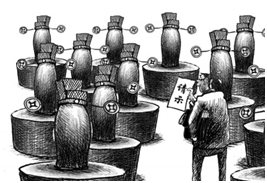
Super ministry reform aims at consolidating administrative bodies of the government and clustering related functions of the public service to reduce duplication and to associate interdependent responsibilities for better coordination and enhanced effectiveness. Also, it aims to move the administration away from micro management of the economy and toward a more supervisory, regulatory, facilitative role.
Since 1982, there are 5 large-scale administrative reforms in China. After the super ministry reform, the number of ministries went from 70 to 27. Though it’s a further step away from the planned economy era, we still have too many ministries compared with other countries with a mature market economy: the Cabinet of the United States only has 15 departments, Japan has 11, and Germany has 14. Why are so less departments? A very important reason is that most of these countries have implemented the super-ministry system, those agencies with similar functions, those institutes with relatively close business scope are co-located to handle the official affairs. Taking Germany's Federal Ministry for the Environment, Nature Conservation and Nuclear Safety for example, the range of its jurisdiction is equivalent to China's Ministry of Environmental Protection, the National Energy Bureau and the National Defense Science and Technology Industrial Development Bureau and other departments.
But why are so many Chinese government departments? In my opinion, there are two reasons. One is the legacy of the planned economy. Administrative system established in 1949 met the needs of the planned economy. The characteristics of the planned economy are that enterprises are vassalages of the government rather than the main bodies in the market, each category of enterprises corresponds to a government department -- it is these government departments that decided what enterprises should produce, how much to produce: In the era of planned economy, in order to manage mechanical industry, eight Ministries of Machinery Industry had been established in total.
As the boom of market economy, non-state-owned enterprises has grown to be the important part of the economy, and such development helps to reduce some government agencies. It is the very background of the administrative reform in 1998. In that reform, the vast majority of departments of the State Council began to take a facilitative role in management of social affairs, and agencies similar to the Ministry of Machinery Industry only taking industry management as the main task gradually withdrew from departments of the State Council.
The other reason is that administrative departments have too much power. In those countries with a mature market economy, the legislative, administrative and judicial departments practice the separation of powers with checks and balances between each other. In general, the number of administrative branches is decided by the parliament, and they are strictly supervised. A very simple reason is that mechanism operating expenses need the parliamentary approval, if there is a budget not approved by the parliament - the administrative departments are powerless to expand the scale. But in China, due to too much power of the administrative agencies, the expansion of the administrative bodies scale is also very natural.
With the deepening of the market, many previous seeming inconspicuous fields have become hot favorites, while the previous seemingly popular fields have become hot potatoes. If it is the former, there will be competition for competence from multiple departments; If it is the latter, then there will be multiple departments imputing their errors to others. In 2009, in the battle of the approval authority of Netease "World of Warcraft", the debate between the Ministry of Culture and the General Administration of Press and Publication on Internet publishing rights is one of the most obvious examples. The online games market has developed rapidly. The Ministry of Culture and the General Administration of Press and Publication both want to become the competent authority of the network game. With such multi-management, it leads to the increase of enterprise cost, and even can cause the situation of "Innocent people get into trouble on account of others' misfortune". Therefore, in order to reduce coordination cost between the enterprises and government, the super-ministry system is an ideal option.
So, will it produce “the more concentrated, the more bureaucratic " phenomenon caused by the department power expansion as many people said after the super-ministry reform? In fact, this worry is not necessary. For the government, the super-ministry reform is to reduce the communication cost; for the enterprise, it is to find the responsible entity. In the precondition of modern administrative law, once the administrative agencies fail to fulfill its statutory powers, which can become the reason for some administrative relative persons claim the related right, and the administrative relative persons don't need so many similar administrative organs to screen carefully, and to bother about them.
Of course, "power results in corruption, and absolute power results in absolute corrupts ", if the legislative institution and people lack effective supervision on the super-ministries, then the super-ministry system also can generate a variety of problems. Even so, we still need to clarify that "the super-ministry reform is not leading to a big government", on the contrary, it can reduce the size of the government, make the boundary of market, society and government more clearly.
Originally published on Southern Metropolis Daily | 2013-1-22


