

China is in the first half of the Environmental Kuznets Curve
On January 14, the Chinese version of the report "Toward an Environmentally Sustainable Future: Country Environmental Analysis of the People's Republic of China" was jointly published by the Asia Development Bank and Tsinghua University. The report shows that seven of the world's top 10 polluted cities are in China; in 500 cities across the country, less than 1% cities meet the air quality standards recommended by the World Health organization. This report came just in time, in these days, many places across the country were shrouded by long-term wide-range fog and haze, and a total of 33 cities had been seriously polluted.
Where did the pollution come from? According to the research by the Asian Development Bank, the direct cause of the fog haze weather is the emissions of the vehicle exhaust, and at the same time, energy production and industrial production are the main sources of air pollution. Many researchers also found similar results. For instance, Zhuang Guoshun, the director of the Center for Atmospheric Chemistry Study at Fudan University also came to similar conclusion after the long-term follow-up study: among manmade sources of PM2.5 in 2000, the ratio of industrial emissions to vehicle exhaust emissions was 7:3, but recent figures show the ratio is now 5:5. That is to say, vehicle exhausts have accounted for an increasing percentage of PM2.5. Of course, pollutant sources of different cities may vary. In some cities, the largest pollutant is vehicle exhaust emissions, in some cities, it may be industrial pollutions, and others may be due to the central heating in winter...
Then, how to control the pollution? A method often mentioned is to strengthen routine supervision and increase penalties of violations. However, after the environmental compliance of all enterprises, is there no pollution? The answer is no. As we living in the world, there are always pollutions, and absolute safety is a chimera. Any activity has risks, only differing with probabilities. When we say that a certain degree of pollution is safe, in fact, we mean the residual risk can be accepted or can be tolerated, rather than the risk does not exist.
More importantly, reducing pollution is costly. There is no free lunch, regulation policy has costs: there are compliance costs for enterprises to abide by the regulation, it also needs corresponding survey cost for regulatory authority to supervise routine production. All these costs are ultimately borne by the consumers. The problem of reducing pollution eventually transforms into: How much are we (consumers) willing to pay for the good environment?
Put it in this perspective, the severe pollution in China is the result of residents’ seeking of living convenience: the increase in vehicle exhaust emissions is due to our quest for travel convenience; the central heating improves indoor comfort while sharply raising coal consumption…If we live a life just as 30 years ago, environmental pollution must not be so severe. Taking the automobile for example, according to the data of the Ministry of Environmental Protection, compared with 1980, the total quantity of automotive vehicles in China increased by 30 times in 2011, and is up to 217 million. And so many cars play an important role in air pollution.
Of course, some people may question this view, an obvious example is why the car quantity in big cities of many European and American countries is higher than that in China, but the air quality is better than in China? One of the important factors is the standard of automobile exhaust emission. The data from the Ministry of Environmental Protection shows, in 2012, the cars reached the standard of China IV, China Ⅲ, China II, and ChinaⅠrespectively accounted for 5.7%, 48%, 19.8%, 17% of the total, and the remaining 9.5% of the cars even cannot meet the standard of ChinaⅠ. However, the standard of car emissions in most of cities of Europe and the United States reached the standard of European IV. As the standard goes from I to IV, the corresponding emission limit is lowering: Compared with China II, the emission limit of China Ⅲ is lower by 30%, China IV is further reduced by 60%.
Higher standards will result in less pollution, why China cannot take the mandatory measures to adopt China IV? Cost is a very important factor. Automobile exhaust emissions are not related to the discharge device of automobile itself, but related to the quality of refined oil. If a car exhaust device is in accordance with China IV standard, but if the gasoline can only meet China III standard, then the tail gas emitted also cannot reach the standard of China IV. When we require the oil refinery to provide the qualified China IV product, it means that the traditional production process must carry on the improvement, the equipment needs to be updated, and all of this is costly.
Further, consumers should pay more for higher-quality gas. While there’s no big increase in household income, low-quality gas will still be the choice for most consumers. In fact, this explanation is not only suitable for automobile emission, but also related to all kinds of pollution.
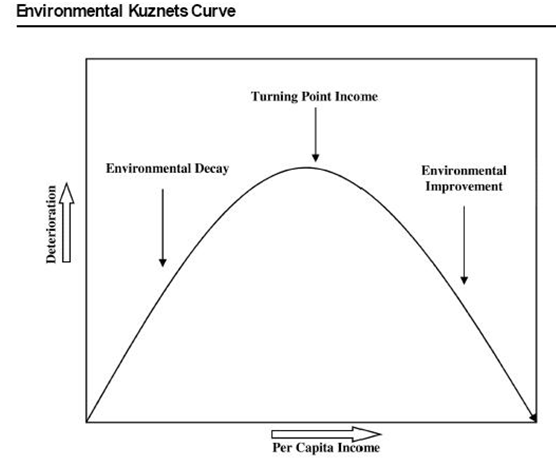
In a word, these haze days actually result from every consumer instead of the omission of regulators. Since per income in China is still low, it is just a wishful thinking to have good environment now. So, how will be the future environment? Environmental Kuznets Curve can explain it. In 1991, the economists Grossman and Krueger made the analysis of cross section data in different regions of a number of countries -- including emissions and per capita national income level relations change of 14 kinds of air pollution and water pollution in recent 12 years, and they found a rule: the degree of pollution will first becomes gradually serious with the increase of average per capita income, then, when average value of the national income exceeds a certain level, the degree of environment pollution will begin to decrease, similar to the Kuznets Curve, there will be an inverted U-shaped curve, and the peak is about at the "middle-income stage".
Nowadays, China is likely to be in the first half of the environmental Kuznets curve -- the pollution degree is gradually serious with the national income increase. What shall we do now? In the near future, the most fundamental way is to develop the economy. Only when income increases, may we pay more in the environment, then pollution can be solved. It is the past lessons of the developed countries, and it is also the reality we have to face today.
Originally published on Southern Metropolis Daily | 2013-1-21


