

Don’t be afraid of China’s Zombie Companies
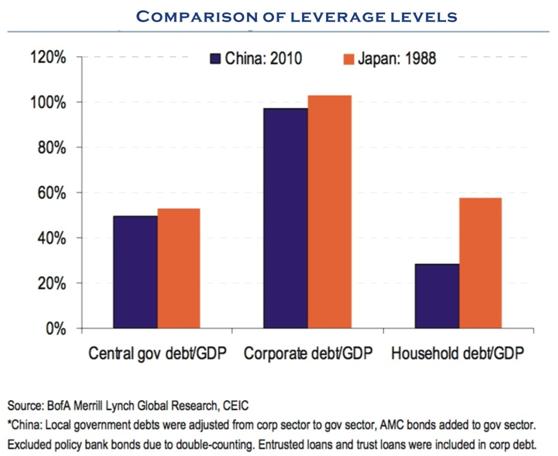
Recently, the article zombie companies hit Chinese banks drew my attention. Actually, “zombie companies”, first put forward by Peter Coy, an economic commentator in the US, means those enterprises without commercial vitality can still survive on the verge of bankruptcy due to the support from lenders or government. Official numbers suggest that the Chinese banking system's ratio of non-performing loans was unchanged at 0.9 percent in the second quarter. However, Winnie Wu, a banking analyst of Bank of America Merrill Lynch, pointed out the data actually is concealing a major risk to the Chinese economy– these zombie companies are holding the country back from real economic growth and threaten to throw the economy into a painful lost decade reminiscent of Japan's experience.
This article offered us some food for thought, yet it seems to me that, to some extent, it didn’t hit the nail on the head of the problem. As was prescribed in this article, the non-performing loans in the banking sector aggregated up to RMB 456.4 billion yuan by the end of the second quarter of this year, representing a continuous rise for three consecutive quarters. As from the early this year, a series of enterprises, such as, Jiangsu Zhongjiang Investment Co., Ltd., Jade Cargo International, Jiangsu Rongsheng Heavy Industries Co., Ltd. etc., drew the attention and concerns due to their huge amount of non-performing loans related to the banking sectors. Yet, from the perspective of the basic economic logic, the rise of the non-performing bank loans is quite normal during the period of the economic downturn, which represents an inevitable phenomenon of the economic cyclical fluctuation. However, in such a process, those enterprises highly relying on the high leverage for business expansion in the previous period are certainly confronted with the debt problems against the backdrop of the less market demand and the increase of the inventory and the adjustment of the industrial structure, thus dampening the loan quality of the banks. So we have to pay more attention to this phenomenon, yet at present, we have no reasons to wildly regard it as the vital factor to plunge China’s economy into “a lost decade”.
The past decade witnessed huge development of Chinese banks: in 2002, Chinese banks were regarded to be “technically bankrupt”, but ten years later, they has firmly occupied a position in the world banking industry through the capital injection, divestment, restructuring, IPOs and many other approaches coupled with China’s fast economic development. Nevertheless, problems currently confronting Chinese banks are at least a far cry from it was faced with a decade ago.
Although I do not take the pessimistic attitude towards the future of Chinese banks as uttered by the abovementioned article, yet banks’ problems really exist. First of all, due to the government’s intervention of the banks, they are required to help “Zombie enterprises” out of trouble. Under the governance structure of China, enterprises, either state-owned or privately owned, should undertake some social responsibilities. If we just deal with problems by following the market mechanism and let the debt-ridden enterprises go bankrupt, it goes without saying that it may trigger the social unrest and instability and cause more social risks, so it is justifiable for banks to relieve these enterprises. However, such actions inevitably bring moral risks and will invigoratively distort the economic system, thus there appearing “too-big-to-fail enterprises” in the local areas. On the one hand, the control of the enterprises’ bankruptcy may render the society instable, yet on the other hand, the relief of the debt-ridden enterprises may distort the interests. So at present, the government should make the tradeoff between the two and should not sacrifice one at the expense of the other.
Either to solve the current problems or the future problems confronting the banks, particularly the non-performing loan problem, it seems to me that there are two basic philosophies we should prioritize. One is how to pull the entire economic system out of the difficult situation and get it back on the normal track for sound development as soon as possible. Currently, China has favorable factors to fuel its further economic development, such as the ongoing urbanization, but faces some other unfavorable factors like the rising cost of the manufacturing industry. So in such a situation, the central government and the local governments should pool together their energy to think over as to how to utilize the favorable factors and mitigate the complications caused by the unfavorable factors. As long as the economy can be brought back for fast growth, the problems besetting banks may be naturally reduced.
The other is to abide by the financial innovation, which involves the innovation of the financial institutions, the innovation of the financial products and the innovation of the financial processes. On the one hand, China currently has the huge amount of surplus capital, but on the other hand, many enterprises in its substantial economy fall short of capital, which shows the credit market and the credit system that bind together the capital demand and supply have gone amiss, so our financial supervisory authority and the financial enterprises should make the concerted efforts to change the current embarrassing situation so that we can rationally allocate the capital where it is urgently needed and attract the capital from investors (or depositors) with the different risk and benefit preference.
As for the near future, it is totally unnecessary for us to have the excessive or groundless worries or anxieties, but anyhow, we shouldn’t feel well at ease about it, which is actually a self-delusion. The key lies in that we should clearly identify the problems and size up the actual situations so that we can suit the remedy to the current situations.
Originally published Time Weekly | 2012-9-27


