

Tax Legality and Budget Democracy
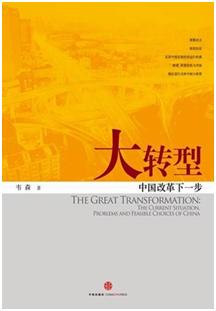
The Great Transformation:the Current Situation, Problems and Feasible Choices of China
Written by Li Weisen
335 pages; CITIC Press,
2012
In 2008, encouraged by the miracles of China’s economic growth, Brandt and Rawski, two famous scholars on Chinese economic issues, began to compile a reference-type handbook which collects papers of dozens of most famous experts and scholars on Chinese economic issues in North America, aiming at making a comprehensive analysis on the “great Chinese economic transformation” in their eyes. Now it appears that the year 2008 is very likely the turning point on the road of China’s transformation. Beijing Olympic Games may be regarded as the coronation for China’s 30 years’ reform achievements, but the consequent economic recession exposed the other side of China’s transformation, i.e. the unbalance of economic structure and high environmental costs. These have also formed the double image of the understanding on China at home and abroad in recent few years. Therefore The Great Transformation: the Current Situation, Problems and Feasible Choices of China, a new book of written by professor Weisen obviously expresses the same opinion: China is still in the process of the great transformation.
Why can China have the great economic transformation? In the essay “A Gradually Formulated Chinese Model” of the book, professor Weisen believes that it’s no doubt that the strength of market economy leads to the prosperity of Chinese economy today. From the viewpoint of mainstream economics, this is the direction suggested by the “Washington Consensus” — economic openness privatization, free market and protection of property rights. But the Chinese development is also unique, and is even summarized as a Chinese model, such as advocating state preponderance, Concentration of resources to make great programs, and strong economic intervention by government, etc. In the events of financial crisis that started in 2007 and the European debt crisis that still exists, China’s state capacity has become envied by politicians of various countries.
Why is China still in the process of the great transformation? Because it is from the last year that we come to know that China model really costs much. After 4 trillion yuan stimulus was released, though the economic growth rebounded quickly, what followed were the soaring price and the unbearable local government debts. As an observer of this process, professor Weisen specially emphasizes that nothing-to-do is also an option for the macroeconomic policies. If there are too many and retrofit intervening measures, they may cause continuous market turmoil instead.
Why happens as such? Weisen analyzes that strong and uncommitted government behaviors, in the process of intervening economy, have formed a special social system of rent-seeking by various levels of governments. The uniqueness of China also lies in that at the time when the market economy is shaping, markets themselves are led and even totally controlled by powerful government. Therefore, such phenomena as advance of state sector and retreat of private sector, hotness of civil service competition, and frequent adjustment of macroeconomic policy, occur without much surprise. If economic reforms in the past three decades are regarded as transformation of a system of position-based authorities to a system of property-based rights, China is still on the way of great transformation. We can not help but ask the question: what’s the future of China after 30-year’ market-oriented reforms?
Before answering it, we have to answer another question — why should China promote the marketization reform? In his new book The Great Transformation, Weisen reviews the 30-year’s reform and openness, and believes that there were three great events that should be recorded in history: the convening of the third plenary session of the 11th party congress, Xiaoping’s south-tour speeches and participating into WTO. The third plenary session of 11th party congress and Xiaoping’s south-tour speeches all aim at increasing the autonomy and activeness of market players, with the passage of a batch of laws as hallmark, such as Company Law and the Guaranty Law. Thus market has expanded and deepened, and economic growth has been speeded up.
Nevertheless, it is after joining into WTO in 2001 that China experienced its most rapid economic growth because WTO membership promoted the changes of domestic market economic system. With the progress of globalization, global capitals seek profits, and require national treatment and a fair, impartial and open market economy. In order to satisfy these requirements, China began to successively release a series of laws that restrain the government intervention, including Legislation Law, Administrative Permission Law, and Administrative Procedure Law,Regulations of the People's Republic of China on the Disclosure of Government Information etc. In order to develop the market economy, the hand of powerful government shall be firstly bound. As a result, there were the golden decade of high speed growth after China’s entry into WTO.
With the development of export-oriented economy, the pressure from abroad has even been described as “US government seeking welfare for the commons of China”. But the outside pressure has enabled China to form and solidify the market economy. What the outside capital needs is just a fair competition, it cannot upgrade the status of private enterprises, neither can increase the wages of labor and improve the protection of environment. To the worse, they have even enjoyed the cost advantages unique in China. Therefore the next catalyst to promote Chinese reforms can only come from inside. China has already nominally set up market mechanism, but still been short of rule of law and democracy that match with a well-ordered market economy.That is why Premier Wen Jiabao once said, “if there is no assurance of political reforms, achievements of economic reforms will be lost at last”.
Obviously, political system has no incentive to automatically reform. On May 30, 2007, announcement of Ministry of Finance to collect stock trading stamp tax led Weisen to realize democracy centers on tax and budget. In the discussion of the book, he summarizes it as “the problem of restricting government’s right of taxation and supervising government expenditure by the representatives of commons”. This idea has formed the major work of Weisen in recent years — appealing for revenue legalization and budget democracy.
If we want to bind the hand of powerful governments, we have to look carefully into their money pockets: where the money comes from and where it goes, i.e. taxation and budget. Therefore tax payers should ensure the government’s proper behaviors through their true representatives and through legal procedure to monitor and examine the taxation behaviors of government. Taxation legality has also become the most important political idea of constitutional states since modern times. The authority of government shall be defined by the representatives elected by people, and then the tax amount shall be decided, completing a logical process from budget to taxation. So taxation legality and budget democracy--budget shall be decided by the representatives elected by people and through legal procedures--have provided technical tools for the public to understand, monitor and determine government behavior and performance.
Though the current situation of rule of law in China is not entirely satisfactory, the above-mentioned idea of reform is not just an imagination. And it start o effectively restrict government behavior in reality. It is evident from fighting for the control of relevant laws and legislation by Ministry of Finance in recent years. At the end of July this year, SIFL and the Research Institute of Economic Thought and Economic History of Fudan University that is taken charge by professor Weisen jointly hosted a seminar disscussing the draft amendment to Budget Law, with the main aim as firmly sticking to the bottom line of budget democracy.
The great transformation of the society, after all, is the change of idea. Taking an overall view of the Great Transformation, there are not so many theoretical innovation and idea breakthrough. But in the work of elucidating clear ideas, professor Weisen is content with it. The process of demonstrating knowledge is also the process of lightening himself. Just due to such efforts, professor Weisen has generated no small influences on public opinions and influenced others. Therefore the focus of promoting reforms by internal affairs lies in changing the ideas of nationals. We need more scholars engaging it, only by doing so, can the great transformation of China succeed.
Originally published on Shanghai Securities News | 2012-9-8


