

Fiscal Risks Exist in the Investment on Infrastructures in West China
On June 29, the Research Result Press Conference on Urbanization and Local Government Debt Risks was held in Shanghai. The subject of Infrastructure Investments: Fund Sources, Investment Efficiency and Local Government Fiscal Risks that was taken charge of by Huang Shaoqing was released. The study is one of the sub-subjects of “urbanization and local government debt risks” that is organized by Shanghai Institute of Finance and Law and Liu Hongru Financial Education Foundation.
The research result finds that the percentage of total investment on infrastructures in 28 provinces that occupies the total GDP of these provinces has a tendency of gradual increase year by year since 1980s of last century. Besides, there is a regional difference for the above proportions. For example, the percentage of infrastructure investments of west China in 2010 occupied obviously much higher than shares in other regions.
From 2004 to 2010, the total infrastructure investment in China had increased 2.59 times, and the annual increase rate was 23.77%. Especially after 2008 global financial crisis, in order to effectively cope with financial crisis and keep stable and rapid economic development, the central government had released a series of measures to expand domestic demand. The investment on infrastructures increased 1,641.466 billion yuan and 1,057.621 billion yuan respectively in 2009 and 2010, and the absolute growth rate was 40.39% and 18.54% respectively.
In 2010, the percentages of investments of all provinces on infrastructures that occupied local governmental public fiscal expenditures were generally rather high, and the average rate was 90.9%. Among them, provinces with percentages over 100% were as many as 9 provinces, and from high to low in turn were: Fujian, Inner Mongolia, Hebei, Tianjin, Guangxi, Liaoning, Hubei, Hunan, and Shanxi.
The investment on China’s infrastructure mainly came from budgeted government funds, domestic loans, FDI, local governments’ self-collected money and other funds. Among them, local governments’ self-collected money contributes most among these five financing channels and its proportion maintains at about 50%.
Since it’s substitutive between instructional capital and productive capital, we can judge whether the investment on infrastructure is efficient by comparing the two capitals’ marginal capital-output ratios. If instructional marginal capital-output ratio is equal to the productive marginal capital-output ratio, then the investment on infrastructure is efficient; infrastructure is in shortage when the ratio is higher than the later, while more investment on infrastructure means a waste when the ratio is smaller than the later. Based on this theory, Huang Shaoqing’s research results shows that in 1997, after price adjustments in most China’s provinces, the marginal output rate of instructional capital and productive capital was greater than 1, indicating that at that time, China was obviously in the situation of infrastructure shortage. In Asian financial crisis in 1998, China’s government made a package of large scale infrastructure investment plans. Then for most provinces of China, after price adjustments, the index measuring infrastructure investment efficiency rapidly slid down in five years after 1998 to nearly 1.
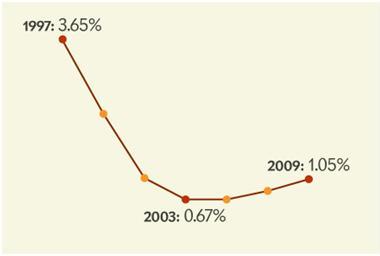
Improper investments between instructional capital and productive capital also hurt the growth of GDP. According to Huang’s estimation, “In 1997, due to insufficient infrastructure investment compared to productive investment, China lost about 3.65% of GDP. In 2003 and 2005, the loss was only 0.67%. And the 4 trillion yuan ($586 billion) stimulus package that was started in 2008 led to relative surplus for infrastructures. In 2009, the loss rose again to 1.05%. Up to today, the loss is surely still expanding.”
The potential loss of China’s GDP led by mismatchbetween instructional capital and productive capital
From the influence of the economic stimulus package in 2008 on local fiscal risks, Huang Shaoqing indicates that through calculating the increased present value of tax revenue by infrastructure investments and the extra-budgetary infrastructure investment amount in 2009 (the present value of the future 30 years’ revenues is calculated with the discount rate of 10%), it is found that fiscal risks are not brought in by most local governments due to the economic stimulus plan. But for the local fiscal revenues of Qinghai, Xinjiang, Yunnan, Guizhou and Inner Mongolia, the extra increase part may be difficult to compensate the investment costs, and fiscal risks exist.
“The five provinces are all western provinces, and it indicates that the investment on infrastructure of the 4 trillion economic stimulus package is too much. Considering the related low efficiency, these governments’ loan repayment ability is worrying.” Huang emphasized, “When local governments are carrying out large scale infrastructure investments, it was necessary to keep pace with investments on private productive facilities. Otherwise, resource mismatching will do harm to the economic growth in the region and increase fiscal risks.”
(www.yicai.com | Reporter: Xu Huiyun | 2013-6-30)


