

The second season of China’s economy:challenges and opportunities
On November 21, 2013, Mr. Chen Xingdong, managing director and chief economist of BNP PARIBAS (China) Co., Ltd., was invited as the guest speaker for the 17th installment of Hongru Forum, and made a speech with the title of “the second season of China’s economy: challenges and opportunities,” sharing his opinions on the past reform achievements with the honored guests, and looked forward challenges and opportunities of China’s future economy.
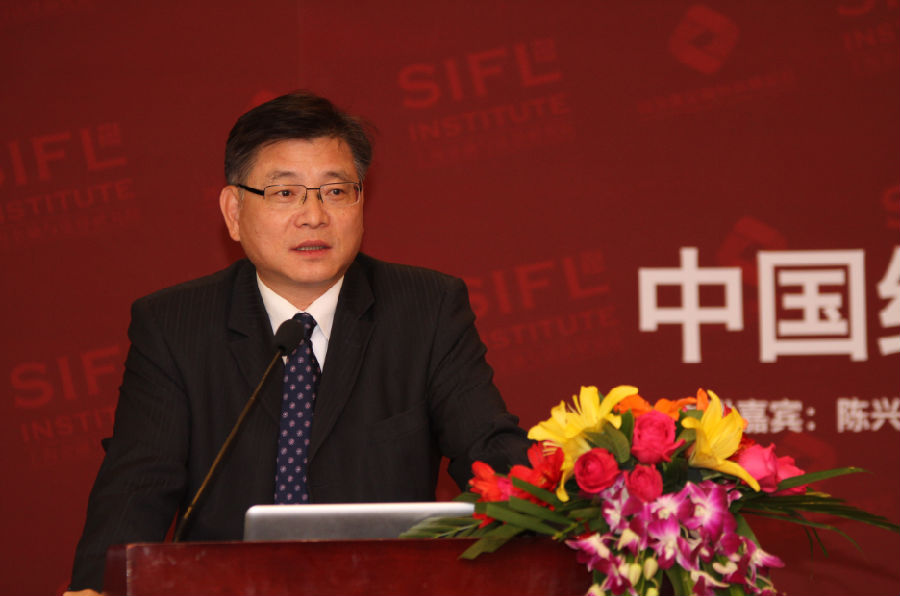
Through reviewing the achievements of China’s economy in the thirty years’ reforms and opening up and the comparison of GDP between China and the U.S. over the years, Chen pointed out that the success of China’s economic growth should owe to the opening up and reforms. Also, China has provided new development choices for developing countries: labor force, capitals, land, environment, technical simulation and absorption all have brought in dividends for reforms, and FDI and exports have even become the leading engine for China’s economic growth.
With relatively slow growth of China’s economy in recent years, many people worry that China can’t avoid repeating the mistake of Japan. Chen stated that there are two major differences between China and Japan--greatly unbalanced regional development and uncompleted urbanization respectively. Chen thought the two differences may become advantages for China’s economic development.
For challenges in the second season of China’s economy, Chen quoted the statement of President Xi Jinping on APEC conference -- “weakened demand, excessive production capacity, local government debts and shadow banking” are the most pressing issues. Besides, China’s economy still suffers the heavy-handed intervention from local governments and serious monopoly of state-owned enterprise, which lead to low efficiency. In Chen’s opinion, the increasingly serious aging population, the poor income distribution and energy-intensive manufacturing pattern in China will restrict the future economic growth in addition.
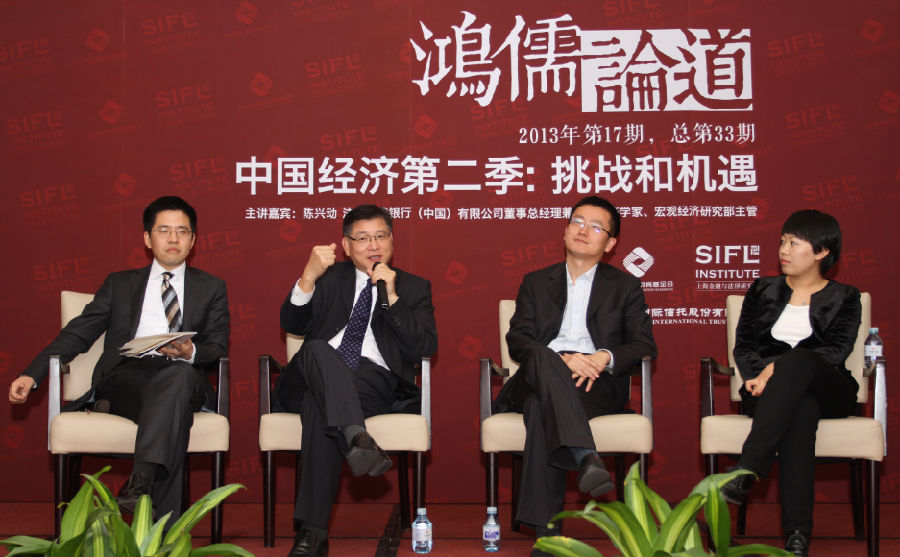
Though there are quite a lot challenges, Chen is optimistic about China’s economy. His reasons are as follows: Firstly, viewing from the scope of the whole country, due to the unbalanced regional development, China is still in the process of industrialization and urbanization, in which exists many opportunities; secondly, considering severe governmental intervention, there will be many ever-suppressed economic growth opportunities such as service industry to be greatly released after reforms. The future reforms will bring in huge dividends for economic development, and this is also inseparable with the commercial features of the Chinese people.
Zhang Ming, director of the Department of International Investment Institute of World Economics and Politics, Chinese Academy of Social Science, Jiang Ping, Associate Professor of International Trade and Economics of the University of International Business and Economics, provided commentary, and SIFL’s executive president Fu Weigang moderated.
Zhang Ming gave his judgments about future economy: Firstly, China’s asset-backed securitization will has great development in the next five to ten years, for it is the only good and market-oriented tool that can be used to cope with governments’ large-scale non-performing assets. Secondly, there are good investment opportunities of dollar-based assets. Thirdly, the de-leveraging of China’s real estate market will accelerate, and the related industrial concentration ratio will sharply rise. Finally, the prices of gold will go down.
For the issue of the liberalization of capital accounts in the Free Trade Zone (FTZ), Jiang Ping expressed her doubt. She believed that once the capital accounts in the FTZ are opened, it may trigger large-scale capital flight which severely hit A share market. For this, Chen pointed out that capitals can only gain the best allocation through free flows, and China now has entered the stage of worldwide resource allocation which urgently requires the two-way opening-up of capital market.
“Hongru Forum” is a public seminar jointly launched by Liu Hongru Financial Education Foundation and Shanghai Institute of Finance and Law, and is held regularly once in two weeks. The seminar pays attention to various issues in China’s finance and macro-economy, and devotes itself to building a platform for cross boundary exchanges among excellent scholars, government and market institutions. Since August 2013, “Hongru Forum” has gained the exclusive support of Chang’An International Trust Co., Ltd.


