

Is China falling from debt cliff?
On November 14, 2013, Dr. Shao Yu, chief economist of Orient Securities Company Limited, shared his opinions about the current situation and policy responses for China’s local government debts with 100 guests in the 16th installment of “Hongru Forum”. Zheng Chunrong, vice-president of the Institute of Public Policy & Governance of Shanghai University of Finance and Economics, and Li Zhiguo, Associate Professor of the School of Management of Fudan University offered comments.
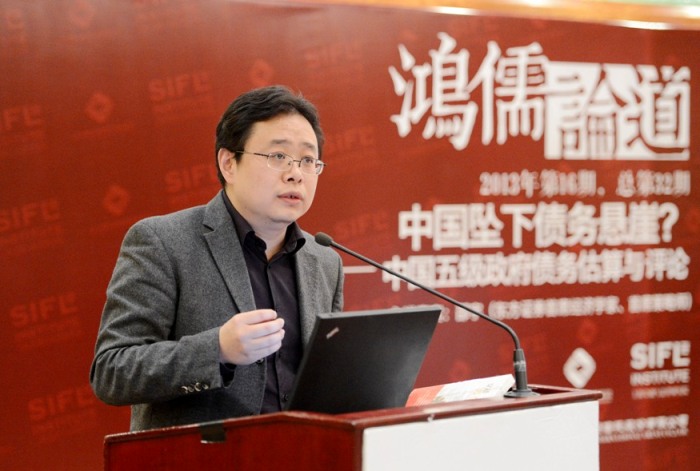
Dr. Shao stated that the biggest risk of China’s government debts was the liquidity risk. According to different investment fields, local government debts can be distinguished as welfare debts, military debts and constructive debts respectively. Though the first two have high default possibility, the latter one may be covered by its future cash flows. However, governments invest various infrastructures financed by constructive debts, which will cost a long time to repay the total.
Because local governments raise new debts for repaying old debts, Dr. Shao believed it was a “Ponzi Game.” According to his estimation, the solvency gap in 2014 is 1.67 trillion yuan, and the next two year will be 2.6 trillion yuan and 1.64 trillion yuan respectively. Though the funding gap is big, Dr. Shao pointed out that there would be money illusion for a very long time for China is in the stage of economic development: as long as the economy can grow, the balance can still be maintained between the government debt repayment and land income increase.
As for China’s government debt structure, Shao also provided specific statistic data. He pointed out that in 2013 the debt of the central government was 12 trillion yuan, and that of local governments was nearly 20 trillion yuan. At the same time, because the debts of the central government mainly concentrate upon China Railway Corporation, as the railway investment and financing mechanism is being reformed, we needn’t worry about the debts of the central government too much. But the debts of local governments are worrying. Hereby Shao pointed out that the central government can “raise leverage,” but local governments should “shift leverage,” i.e. local debts are transferred to the central government, government debts are transferred to residents, and domestic debts are transferred abroad -- he especially emphasized that the assets of residents are 180 trillion yuan while their liabilities are only 10 trillion yuan.
Making a general survey of the debt repayment structure, Shao addressed that 80% of the repayment for debts of the Chinese government is from the expected income of land-transferring, only 5% is from fiscal fund repayment. What is worrying is that only 20% of land-transferring fees is the disposable income, and only 30% of the fiscal revenue is debt-repayable. Shao Yu estimated that even the current system for land supply is maintained, there are only 15 years for selling land for the government, therefore, the debt paying ability with the pattern of driving investments by land is limited, and hereby even the reforms of China’s fiscal system can be reversely forced.
Dr. Shao put forward two suggestions to solve the government debt risks. In the short time, the financing scale of China’s government should not be reduced, and otherwise the liquidity risks can emerge. But the government must adjust the financing structure. In the long term, the selling off infrastructure assets of government, the realization of PPP pattern and even the direct privatization are the real solutions for government debts.


